Ethereum is the second-largest cryptocurrency in the world, right after Bitcoin. Yet it’s much more than a digital coin. Ethereum is a global platform where developers build apps for payments, trading, games and much more. So what is Ethereum exactly, and why does it matter?
This guide explains Ethereum in plain language. You’ll learn how the network works, what the ETH coin is used for and how gas fees and staking work. We also compare Ethereum with Bitcoin, look at the upcoming Glamsterdam upgrade and show how to get ETH with a gift card, without a bank card.
Ethereum is a public blockchain that runs smart contracts, which are programs that work without a middleman. ETH is its native coin. You use ETH to pay network fees, to stake and earn rewards, and to use apps built on Ethereum.
What Is Ethereum
Ethereum is a decentralised network of computers that all share the same record of accounts and transactions. Like Bitcoin, it lets people send value to each other without a bank. However, Ethereum goes one step further, because anyone can also run programs on it.
These programs are called smart contracts. They power thousands of apps, from crypto exchanges and lending services to stablecoins and online games. Together, they form a huge ecosystem that people often call “decentralised finance”, or DeFi.
Ethereum at a glance
The ETH coin is what keeps the network running. Every action on Ethereum costs a small fee paid in ETH, and holders can stake their coins to help secure the network. As a result, ETH is both a currency and the fuel for everything built on Ethereum.
A Short History of Ethereum
Ethereum has changed a lot since its launch. These are the most important moments so far:
Key moments in Ethereum’s history
Late 2013Vitalik Buterin publishes the Ethereum whitepaper.
July 2015The Ethereum network goes live.
June 2016The DAO hack leads to a split, which creates Ethereum Classic.
August 2021The London upgrade starts burning part of every fee.
September 2022The Merge moves Ethereum from mining to Proof of Stake.
April 2023Stakers can finally withdraw their ETH.
July 2024The first US spot Ethereum ETFs start trading.
August 2025ETH reaches its all-time high of nearly $5,000.
December 2025The Fusaka upgrade goes live on mainnet.
In other words, Ethereum has grown from a bold idea into the main platform for crypto apps. Along the way, it also switched to a far more energy-efficient way of running.
How Ethereum Works
At its core, Ethereum is a shared database that thousands of computers keep in sync. Each computer, called a node, stores a full copy of the blockchain. When someone sends ETH or uses an app, the transaction is shared with these nodes and added to a new block.
Every block is linked to the one before it, which creates a chain of blocks. Because thousands of nodes check every block, changing past records is practically impossible. That’s what makes the blockchain secure without a central authority.
What makes Ethereum special is the Ethereum Virtual Machine, or EVM. You can think of it as one big global computer that every node runs. Smart contracts live inside the EVM, and every node runs the same code and gets the same result. So when a contract says “send 1 ETH when condition X is met”, every node agrees on the outcome.
Ethereum has two types of accounts. Normal accounts belong to people and are controlled by a private key. Contract accounts, on the other hand, belong to smart contracts and follow their code.
Who Runs Ethereum
Unlike a company, Ethereum has no CEO and no head office. Instead, many independent groups keep it running. That’s one of the main reasons people call it decentralised.
The Ethereum Foundation is a non-profit that funds research and supports developers. However, it doesn’t control the network. Several independent teams build the software that nodes run, so no single bug or company can take the whole network down. Meanwhile, hundreds of thousands of validators around the world secure the chain.
Changes to Ethereum follow an open process. Anyone can suggest an improvement, called an Ethereum Improvement Proposal, or EIP. Developers then discuss it in public calls, test it on test networks and only then add it to a planned upgrade. Because node operators choose which software to run, an upgrade only works if most of the network agrees to it.
Vitalik Buterin, who proposed Ethereum in 2013, is still its best-known voice. Even so, he can’t change the rules on his own, and the network would keep running without him.
What ETH Is Used For
ETH has several jobs on the network. Here are the most important ones:
- Paying fees: every transaction and smart contract action costs a small fee in ETH, called gas.
- Staking: holders can lock up ETH to help secure the network and earn rewards.
- Using apps: many apps on Ethereum use ETH for trading, lending and borrowing.
- Sending value: you can send ETH to anyone in the world, at any time.
- Holding: many people hold ETH as a long-term investment in the network’s growth.
ETH also comes in smaller units. The smallest unit is a wei, and one ETH equals one billion gwei. You’ll mostly see gwei when you look at gas prices.
Smart Contracts Explained
A smart contract is a program that runs on the blockchain and follows fixed rules. Once deployed, it does exactly what its code says, and nobody can switch it off or change the result.
A simple way to picture it is a vending machine. You put in money, choose a snack and the machine gives it to you, with no shop assistant needed. Smart contracts work the same way, only with digital assets. For example, a contract can swap one token for another, pay out a loan or release funds when a deadline passes.
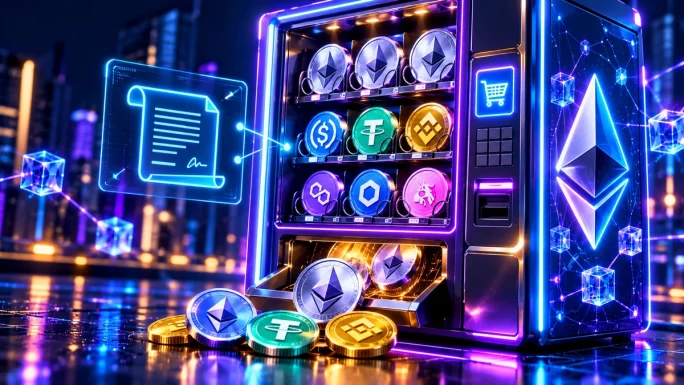
Thanks to smart contracts, developers can build all kinds of apps on Ethereum. Some of the most popular ones include:
- Exchanges: apps that let you swap tokens directly from your wallet.
- Lending platforms: services where you can lend crypto for interest or borrow against it.
- Stablecoins: tokens like USDC that aim to keep a steady value of 1 US dollar.
- NFTs and games: digital items that you truly own and can trade.
Our guide on what USDC is explains one of the best-known tokens that runs on Ethereum.
Tokens Built on Ethereum
Besides ETH, thousands of other tokens live on Ethereum. They are created with smart contracts that follow shared standards, so wallets and exchanges can support them easily.
The most common standard is ERC-20, which covers regular tokens such as stablecoins and many DeFi coins. Every ERC-20 token works the same way, so any Ethereum wallet can hold and send it. Another standard, ERC-721, is used for NFTs, where every token is unique.
There’s one important detail for beginners. Even when you send an ERC-20 token, you still pay the gas fee in ETH. So if your wallet holds tokens but no ETH, you can’t move them until you add a little ETH. That’s why it’s a good idea to keep a small amount of ETH in any wallet you use on Ethereum.
You’ll also often see “ERC-20” when you withdraw coins from an exchange. In that case, it means the coin will travel on the Ethereum network itself, rather than on a cheaper Layer 2 or another blockchain.
Gas Fees Explained
Every action on Ethereum needs computing power, and gas is how the network measures it. You pay for gas in ETH. Simple transfers use little gas, while complex actions, like swapping tokens, use more.
The price of gas depends on demand. When the network is busy, fees go up, and when it’s quiet, they drop. Since the London upgrade, part of every fee is burned, which means it’s destroyed forever. As a result, ETH’s supply grows more slowly, and in busy periods it can even shrink.
Typical Ethereum fees
| Action | Cost on Ethereum | Cost on a Layer 2 |
|---|---|---|
| Sending ETH | Low to moderate | Very low |
| Swapping tokens | Higher | Low |
| Minting an NFT | Higher | Low |
| Busy network | Can spike quickly | Usually stays low |
In 2026, fees on Ethereum are much lower than during the busy years of 2021 and 2022. Still, they can rise quickly when demand jumps. That’s why many people use Layer 2 networks for everyday activity, which we cover below.
Proof of Stake and Staking
Until 2022, Ethereum used mining, just like Bitcoin. Miners competed with powerful computers to add new blocks, which used huge amounts of electricity. In September 2022, the Merge switched Ethereum to Proof of Stake and cut its energy use by more than 99%.
With Proof of Stake, validators lock up ETH to take part in securing the network. They propose and check new blocks, and in return they earn rewards. If they cheat or go offline, they can lose part of their stake.
You don’t need to run your own validator to take part. There are several ways to stake ETH:
Ways to stake ETH
| Option | Minimum | Difficulty | Good to know |
|---|---|---|---|
| Solo staking | 32 ETH | Hard | You run your own validator and keep full control |
| Exchange staking | Very small amounts | Easy | The exchange handles everything for a share of rewards |
| Flexible staking products | Very small amounts | Easy | You can usually unstake quickly, but rewards are lower |
| Liquid staking | Very small amounts | Medium | You get a token that represents your staked ETH |
Staking rewards change over time and are never guaranteed. Also, staking doesn’t protect you from price drops. If ETH falls, a small reward won’t make up for the loss. Our guide to Binance Earn explains how simple staking products work.
Layer 2 Networks
Ethereum can only process a limited number of transactions per block. To handle more activity, developers built Layer 2 networks, often called L2s, on top of it.
An L2 bundles many transactions together, processes them cheaply and then posts a summary back to Ethereum. That way, users get much lower fees while still relying on Ethereum’s security. Popular examples include Arbitrum, Optimism and Base.
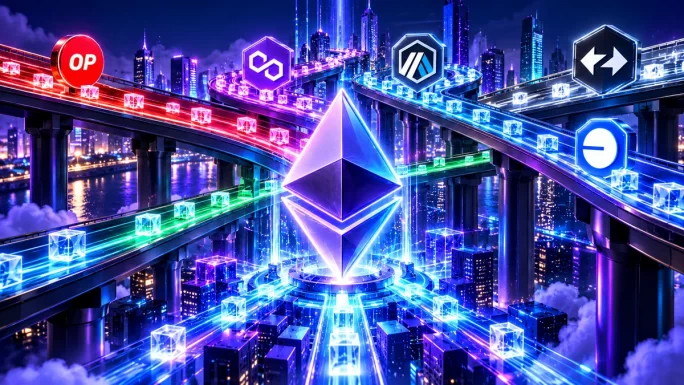
Since the Dencun upgrade in March 2024, sending data from L2s to Ethereum has become much cheaper. Because of that, a simple transfer on an L2 often costs just a fraction of a cent. For beginners, the main thing to remember is to pick the right network when you send or withdraw ETH.
ImportantETH on Ethereum and ETH on a Layer 2 or another network are not automatically the same. Always check that the sender and the receiver use the same network, or your coins can be lost.
Our guide to crypto networks explained shows how the most common networks compare.
The Glamsterdam Upgrade
Ethereum keeps improving through regular upgrades. The next big one is called Glamsterdam, and developers are aiming to launch it on mainnet in early December 2026.
Glamsterdam has two main goals. First, it builds the process of creating blocks directly into Ethereum’s rules. Second, it lets nodes process transactions in parallel. Together, these changes should allow the network to handle much more activity than today.
For regular users, nothing changes in practice. Your ETH stays where it is, and there’s no swap or migration to do. If you stake through an exchange, the provider handles the update for you.
Good to knowOur news article on the Glamsterdam upgrade covers the test dates and the expected launch window in more detail.
Ethereum vs Bitcoin
Ethereum and Bitcoin are the two biggest cryptocurrencies, but they have very different goals. Bitcoin is mainly a store of value, while Ethereum is a platform for apps. Here’s how they compare:
Bitcoin
Main purposeDigital money and store of value
SupplyCapped at 21 million
ConsensusProof of Work, or mining
Smart contractsVery limited
Block timeAbout 10 minutes
Ethereum
Main purposePlatform for apps and smart contracts
SupplyNo fixed cap
ConsensusProof of Stake, or staking
Smart contractsFull support
Block timeAbout 12 seconds
Many people hold both. Bitcoin is often seen as “digital gold”, while Ethereum is a bet on the growth of crypto apps and services. Neither is automatically better, since they do different jobs.
Risks to Know Before You Buy
Like every cryptocurrency, ETH comes with real risks. Before you buy, it helps to understand the main ones:
- Price swings: ETH can lose half of its value in a few months, as it has done several times before.
- Smart contract bugs: apps on Ethereum can contain errors that hackers exploit.
- Scams: fake tokens, fake apps and phishing sites target Ethereum users all the time.
- Wrong networks: sending ETH on the wrong network can mean losing it.
- Competition: other blockchains, such as Solana, compete for the same users and developers.
For example, ETH reached nearly $5,000 in August 2025, but traded at around $2,300 in late October 2026. So only invest money you can afford to lose. Our guides to common crypto scams and what Solana is help you see the wider picture.
How to Get ETH With a Gift Card
If you want to own some ETH, the simplest way for beginners is a Binance Gift Card ETH. It loads ETH straight into your Binance account, so you don’t need to link a bank card. Here’s how it works:
Get ETH with a Binance Gift Card
After that, you can hold the ETH, stake it in a flexible product or swap it for another coin with Binance Convert. If you’re new to Binance, our guide on how to start with crypto on Binance walks you through every step.
Ethereum on Binance
Binance Gift Card ETH
Redeem the code in the Binance app and the ETH lands in your Funding wallet. Small amounts available.
Buy Binance Gift Card ETHFor a detailed walkthrough, see our guide on how to buy Ethereum with a gift card. You can also browse all Binance Gift Cards for other coins.
How to Store ETH Safely
Once you have ETH, you need to decide where to keep it. For small amounts, many beginners leave it on the exchange while they learn. That’s convenient, but it means the exchange holds your coins for you.
For larger amounts, a personal wallet gives you full control. Popular options include software wallets on your phone and hardware wallets, which keep your keys offline. In both cases, you get a recovery phrase, and anyone who sees it can take your coins.
To stay safe, follow a few simple rules. Turn on two-factor authentication on your exchange account, never share your recovery phrase and double-check every address before you send. Our guides to crypto wallets and the seed phrase explain each option in detail.
Frequently Asked Questions
Ethereum is a global blockchain where people can send money and run apps without a bank or middleman. Its coin, ETH, pays for transactions and keeps the network secure.
Ethereum is the network, while ETH is the coin that runs on it. You use ETH to pay gas fees, to stake and to use apps built on Ethereum.
Nobody can say for sure. ETH has grown a lot since 2015, but its price can also fall sharply. Only invest money you can afford to lose, and do your own research before you buy. This guide isn’t financial advice.
It depends on how busy the network is. In 2026, a simple transfer on Ethereum is usually cheap, and on a Layer 2 network it often costs a fraction of a cent. However, fees can rise quickly when demand jumps.
Yes. A Binance Gift Card ETH loads ETH straight into your Binance account, so you don’t need a bank card. You redeem it in the Binance app under Gift Card.
Glamsterdam is Ethereum’s next major upgrade, planned for early December 2026. It aims to let the network handle more activity. ETH holders don’t need to do anything.
Key Takeaways