After the record attack on October 29, 2026, millions of users are asking the same question: is Binance safe? The short answer is that your balance is protected, because Binance has promised to cover every loss. The longer answer depends on how the exchange protects funds, how you secure your own account and how much crypto you choose to keep there.
Yes, Binance is generally considered safe for everyday use. After the October 2026 attack, Binance confirmed that user funds are safe and that it will cover all losses from its SAFU fund and company funds. Your own safety, however, also depends on strong account security, such as an authenticator app, a withdrawal whitelist and an anti-phishing code.
This guide explains the safeguards Binance uses, what SAFU and Proof of Reserves really mean and how the exchange handled attacks in the past. It also shows you, step by step, how to lock down your account, recognise phishing and decide how much crypto to keep on an exchange.
Is Binance Safe in 2026
Binance is the world’s largest crypto exchange by trading volume, and it has operated since 2017. Over that time it has built several layers of protection: an emergency insurance fund, public Proof of Reserves, cold storage for most assets and a wide range of account security tools.
No exchange is risk-free, though. The October 2026 incident showed that even the biggest platform can be attacked, and the difference lies in how it responds. In this case, Binance froze billions within hours, kept user balances untouched and promised full compensation. That response is the main reason the market stayed relatively calm.
So, is Binance safe? For most users, the honest answer is yes, with two conditions. First, you need to secure your own account properly, because most individual losses come from stolen logins rather than exchange hacks. Second, you should avoid keeping all your savings on any single exchange.
Binance safety at a glance
What Happened in October 2026
On October 29, 2026, attackers linked to North Korea drained about $6.3 billion from Binance hot wallets, the largest crypto theft ever recorded. Binance paused withdrawals, froze around $3 billion with the help of industry partners and confirmed that users will not bear the loss. You can read the full story in our Binance hack news report.
For the purpose of this guide, the key lesson is simple. The attack targeted the exchange’s own systems, not individual user accounts. Therefore, users who kept good account security had nothing stolen from them personally, and the exchange is covering the shortfall.
Is Binance Safe to Use Right Now
In the days after the attack, Binance kept trading and deposits running while it paused withdrawals for security checks. The exchange said withdrawals would resume gradually, starting within about 48 hours of its October 30 update.
- Your balance: unchanged and covered by Binance.
- Trading and deposits: working as normal.
- Withdrawals: returning step by step after the security checks.
There is no need to panic or rush to sell. Instead, use this moment to review your own security settings, follow updates only through the official Binance app and website, and ignore anyone who contacts you about the incident directly.
How Binance Keeps User Funds Safe
Binance uses several layers of protection at the same time. Understanding them helps you judge the real level of risk.
- Cold storage. Like other large exchanges, Binance keeps the bulk of customer assets in offline wallets that hackers cannot reach over the internet. The October attack hit hot wallets, which hold only the amount needed for daily withdrawals.
- Risk monitoring. Automated systems watch withdrawals and logins for unusual activity and can block suspicious transactions.
- Emergency fund. The SAFU fund exists to repay users if something goes wrong.
- Proof of Reserves. Regular reports show that customer balances are backed one to one.
- Account tools. Users can add two-factor authentication, passkeys, withdrawal whitelists and anti-phishing codes.
None of these layers is perfect on its own. Together, however, they make it much harder for a single failure to cost users money, which is exactly what happened in October 2026.
What SAFU Is and How It Works
SAFU stands for Secure Asset Fund for Users. Binance created it in July 2018 as an emergency reserve, originally funded with a share of trading fees. Its only purpose is to protect users in extreme cases, such as a major hack.
Today the fund holds roughly $1 billion, kept in bitcoin. During the October 2026 incident, Binance said it would use SAFU together with its own company funds to cover all losses. As a result, the size of the theft does not change user balances, because the company makes up the difference. This fund is a big part of why Binance is safe for ordinary users even after a major attack.
It is important to understand what SAFU does not do. It protects against losses caused by the exchange itself, not against mistakes on your side. If you send crypto to a scammer or someone logs in with your stolen password, SAFU usually will not refund you. That is why your own account security matters so much.
What SAFU coversSAFU is designed for exchange-level incidents, such as attacks on Binance wallets. Losses caused by phishing, shared passwords or sending funds to the wrong address are normally the user’s responsibility.
Proof of Reserves Explained
After the collapse of FTX in November 2022, users wanted proof that exchanges actually hold their money. Binance responded by publishing Proof of Reserves, a regular report that shows how much of each asset it holds compared with what customers have deposited.
The system uses a Merkle tree and zero-knowledge proofs. In simple terms, every user balance becomes part of a cryptographic snapshot, and you can check that your own balance is included without anyone revealing other people’s data. You can find the verification tool on the official Binance Proof of Reserves page while logged in.
Binance has said it will publish an updated report once the October 2026 investigation is complete. When people ask whether Binance is safe, checking that report is one of the best ways to confirm that customer balances remain fully backed after the incident.
Has Binance Been Attacked Before
Yes. In May 2019, hackers stole about 7,000 BTC, worth roughly $40 million at the time, from a Binance hot wallet. They used phishing, malware and stolen API keys to gain access to user accounts and then made a large withdrawal.
Back then, Binance paused withdrawals for about a week and covered the entire loss with the SAFU fund. No user lost money. In other words, the response in 2026 follows the same pattern, just on a much larger scale.
Major security incidents at Binance
| Year | Incident | Outcome for users |
|---|---|---|
| 2019 | About 7,000 BTC stolen from a hot wallet | Fully covered by SAFU |
| 2026 | About $6.3 billion taken from hot wallets | Binance promised to cover all losses |
Two major incidents in nine years is not a perfect record. Still, in both cases the exchange protected customer balances, which is the most important measure of safety for an ordinary user.
Regulation and Legal History
Safety is not only about technology. Binance also has a complicated legal history. In November 2023, the company agreed to pay about $4.3 billion to settle charges in the United States related to anti-money-laundering and sanctions rules. Founder Changpeng Zhao stepped down as CEO and later served a short prison sentence.
Since then, Binance has changed its leadership and invested heavily in compliance. Richard Teng took over as CEO in 2023, and Yi He later became co-CEO. The exchange now holds licences or registrations in several countries, and it requires identity verification for all users.
For users, this history matters in two ways. On one hand, it shows that Binance operated with weak controls in its early years. On the other hand, the settlement forced the company to strengthen its systems, and regulators now monitor it closely. Rules differ by country, so check whether Binance is available and registered where you live.
How to Judge Whether Any Exchange Is Safe
The same checklist works for Binance and for any other platform. Before you deposit money anywhere, look for these signs:
- Proof of Reserves that is published regularly and lets you verify your own balance.
- An emergency fund or a clear policy on what happens after a hack.
- Strong account tools, such as passkeys, withdrawal whitelists and anti-phishing codes.
- A track record of how the exchange handled past incidents.
- Regulatory registration in the countries where it operates.
- Transparent communication during problems, with updates on official channels.
Judged by this list, Binance is safe on most points, and its response in 2019 and 2026 shows that it pays users back. Still, no checklist can remove all risk, which is why spreading funds across platforms and wallets remains good practice.
Is Binance Safe for Beginners
Binance can be a good choice for beginners, as long as you start carefully. The app offers a simple mode, clear security prompts and plenty of educational material. However, it also offers advanced products, such as futures and leverage, which carry much higher risk.
- Start small. Deposit only what you are ready to lose while you learn.
- Avoid leverage. Futures and margin trading can wipe out a balance quickly.
- Set up security first. Add two-factor authentication before your first deposit.
- Learn the basics. Our guide on starting with crypto on Binance walks you through the first steps.
In short, Binance is safe enough for beginners as a platform. The bigger risks come from complex products and from scams that target new users.
How to Secure Your Binance Account
Most stolen crypto does not come from exchange hacks but from compromised user accounts. Fortunately, Binance gives you strong tools to prevent that. Set them up once, and your account becomes far harder to break into.
Lock down your Binance account
The withdrawal whitelist deserves special attention. With it turned on, even someone who gets into your account cannot send your crypto to their own address, because new addresses need extra confirmation and a waiting period. Therefore, it is one of the most effective protections you can add.
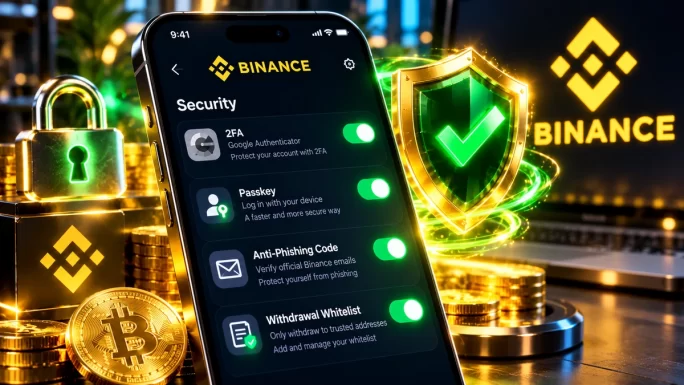
Passkeys and hardware security keys are even stronger than authenticator apps, because they cannot be phished. If your phone supports passkeys, consider using one for logins and withdrawals.
How to Spot Binance Phishing Scams
Even if Binance is safe as a platform, scammers try to exploit the confusion after every major incident. The October 2026 attack is no exception, and fake “compensation” messages are already circulating. Learn to recognise the most common tricks:
- Fake compensation offers asking you to log in through a link to claim refunds.
- Emails without your anti-phishing code, which are almost certainly not from Binance.
- Calls or messages from “Binance support” asking for your password, 2FA code or seed phrase.
- Look-alike websites with small spelling changes in the address.
- Requests to move funds to a “safe wallet” because your account is “at risk”.
Binance will never ask for your codesBinance staff will never ask for your password, 2FA codes or seed phrase, and they will never ask you to move funds to protect them. Check any suspicious email, phone number or link with Binance Verify on the official website.
If you receive a suspicious message, do not click anything. Instead, open the Binance app directly and check your notifications there. Our article on gift card scams in 2026 covers more tricks to watch out for.
What to Do If Your Account Is Compromised
If you notice a login you did not make, a changed setting or a withdrawal you did not request, act quickly. Every minute counts.
- Disable your account immediately through the app or the security settings. This blocks trading and withdrawals.
- Change your password and reset two-factor authentication from a clean device.
- Check your email account, since attackers often get in through a hacked inbox.
- Contact Binance support only through the official app or website.
- Scan your devices for malware before you log in again.
Afterwards, review which devices and API keys have access to your account and remove anything unfamiliar. Finally, turn on the withdrawal whitelist if you have not done so already, because it stops most attacks even when someone knows your password.
How Safe Is Binance Compared With Your Own Wallet
An exchange holds your crypto for you, while a self-custody wallet lets you hold the private keys yourself. Each option has its own risks.
Exchange vs self-custody wallet
| Feature | Crypto on Binance | Your own wallet |
|---|---|---|
| Who holds the keys | Binance | You |
| If the exchange is attacked | Binance covers losses | Not affected |
| If you lose your password or seed | Account recovery possible | Funds may be lost forever |
| Ease of trading | Very easy | Needs extra steps |
| Best for | Active trading and small balances | Long-term savings |
Neither option is perfect, and Binance is safe enough only if you also protect your own access. Self-custody removes exchange risk but puts all responsibility on you, and a lost seed phrase cannot be recovered. Exchanges are more convenient and offer account recovery, yet they remain a target for attackers. Our guide on crypto wallets explains the main wallet types in more detail.
When It Makes Sense to Keep Crypto on Binance
A balanced approach works best for most people. Keep the crypto you trade or spend regularly on the exchange, and move long-term savings to a wallet you control.
- Keep on Binance: funds for trading, small balances and crypto you plan to spend soon.
- Move to your own wallet: larger amounts you plan to hold for months or years.
- Split large sums: avoid keeping everything on one platform.
This way, an incident on one platform never puts all your savings at risk, and you still enjoy the convenience of an exchange for everyday use.
Is Binance Safe for Gift Card Users
Many people top up their Binance accounts with gift cards instead of bank transfers. Redeeming a gift card credits your Binance balance directly, so that crypto is protected in exactly the same way as the rest of your account. Binance has not said that gift card redemption is affected by the October incident.
Gift cards also add a layer of privacy, because you never link a bank card to the exchange. If you want to know more about the cards themselves, read our guide on whether a Binance gift card is safe.

BTC, ETH, USDC and more
Binance Gift Cards
Top up your Binance account without linking a bank card. Codes arrive in your account within minutes.
Shop Binance Gift CardsFrequently Asked Questions
Binance says user funds are safe and that it will cover all losses from its SAFU fund and company funds. User balances were not reduced by the attack.
SAFU is an emergency fund created in 2018 to protect users in extreme cases, such as hacks. It currently holds about $1 billion in bitcoin.
Yes. In 2019, hackers stole about 7,000 BTC from a hot wallet. Binance covered the full loss with SAFU, and no user lost money.
Use a unique password, an authenticator app or passkey, an anti-phishing code and the withdrawal whitelist, and turn on login notifications.
Keep funds you trade on the exchange and move long-term savings to your own wallet. Splitting funds reduces the impact of any single incident.
Redeeming a gift card credits your Binance balance, which Binance says is fully protected. If you prefer, you can wait until withdrawals fully resume.
Key Takeaways