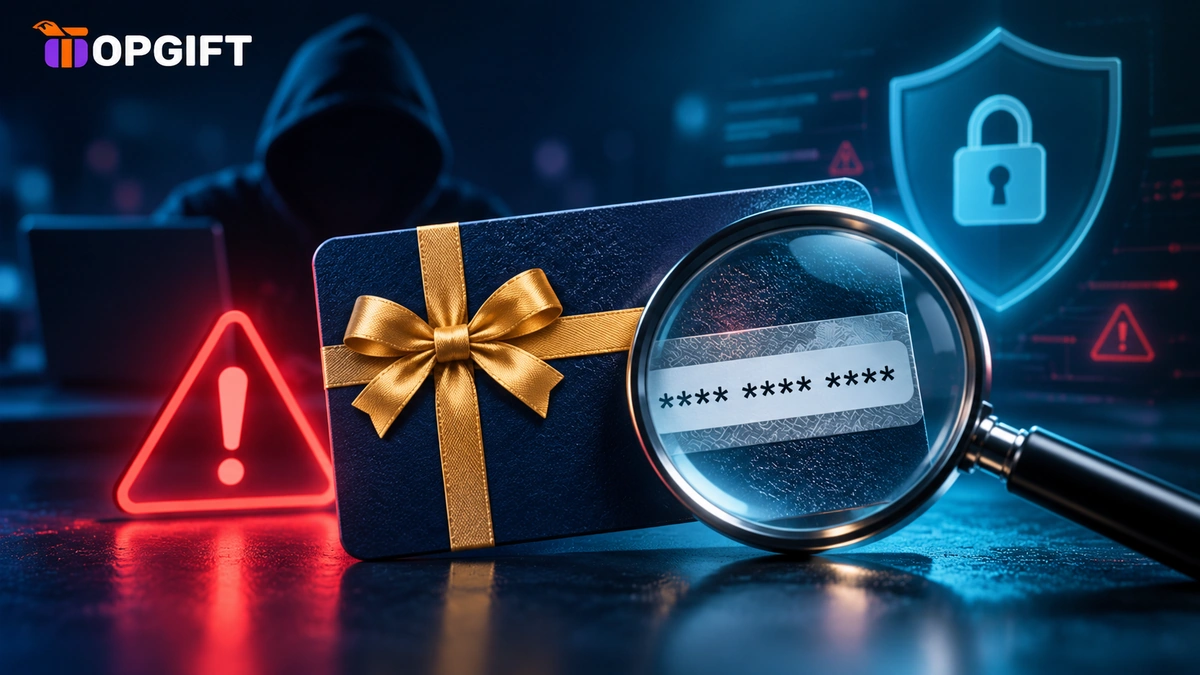
Gift cards remain one of the favourite tools of scammers in 2026. They move money fast, they are hard to trace, and once a code is spent, it rarely comes back. The tricks, though, keep changing. The most common schemes this year don’t look like scams at all. One looks like a small favour for someone you like. Another looks like a tiny fee on a big win. This guide covers the schemes worth knowing now, the red flags behind all of them, and what to do if it has already happened.
In this guide
- Two Very Different Kinds of Gift Card Scam
- The Dating App Scam That Never Asks for Money
- You Won a Prize, Just Pay a Small Fee
- Fake Officials and Fake Bosses
- When the Card Itself Is the Scam
- Red Flags Worth Stopping For
- Buying From a Seller You Can Check
- What to Do If It Already Happened
- Frequently Asked Questions
Two Very Different Kinds of Gift Card Scam
In the first kind, the gift card is only the payment method. Someone persuades you to buy a card and send them the code. The card itself is perfectly real. The story around it is the lie.
In the second kind, the card is the problem. You buy a code that is fake, already used, or obtained with stolen money. Here you are the customer, and the seller is the scammer.
The first kind causes the most losses in 2026, so the next three sections cover its most popular versions.
The Dating App Scam That Never Asks for Money
This one is everywhere right now. You match with someone attractive on a dating app or social network. The conversation is warm, flattering and surprisingly easy. Often it moves to WhatsApp or Telegram within a day or two.
Then comes a small request. Crucially, it is never for money. Instead, it is a gift card. Her phone credit ran out, so could you send a Google Play card to keep chatting? She wants to buy a game with you, so could you get her a Steam card? Some versions ask for an Apple card to “prove you are real” or to unlock a video call.
The trick works because a gift card doesn’t feel like money. It feels like a present. Refusing someone a present seems rude, while refusing a bank transfer seems sensible. Scammers know this, and the first request is usually small on purpose. Once you have said yes once, the next request is larger.
The profile is almost always fake. Photos are often stolen, and in 2026 many are AI-generated. The person writing is frequently part of an organised group working many conversations at once.
You Won a Prize, Just Pay a Small Fee
The second classic arrives by text, email, social media message or phone call. You have won something big: a new iPhone, a car, a cash prize, or a giveaway from a famous brand or influencer. Everything is ready. There is just one small step left.
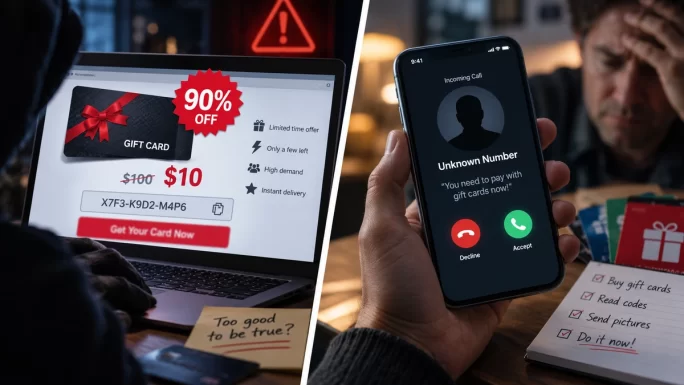
That step is a fee. It might be called delivery, processing, customs or tax. It is always small compared to the prize, perhaps 20 or 50 euros. And it must be paid in gift cards, usually right away, before the prize “expires”.
The size of the fee is the whole trick. Nobody would send 500 euros to a stranger. But 25 euros to claim a 1,000-euro phone feels like a sensible trade. Of course, there is no prize. A real prize never requires you to pay anything to receive it, least of all in gift cards.
Fake Officials and Fake Bosses
The older versions of the scheme still work, which is why they are still around. A caller claims to be from the tax office, the police, your bank, or a utility company. There is always an urgent problem, and it can only be fixed by paying right now, in gift cards.
A variant targets people at work. An email that looks like it came from your manager asks you to buy gift cards for a client, quickly and quietly. The sender’s address is off by a letter, or the message comes from a personal account “because I’m in a meeting”.
The details change, but the core never does. Real organisations do not take payment in gift cards. The moment anyone asks you to pay a debt, a fine or a fee this way, you know it is a scam.
When the Card Itself Is the Scam
The most common version is the code that is simply too cheap. Marketplaces and social media are full of sellers offering gift cards at 40 or 50 percent off face value. No legitimate business can sell a card for half its value and stay open. At that price, the code is usually drained, fake, or bought with a stolen bank card.
That last case causes the most damage. A code bought with stolen card details often works at first. Later, the platform detects the fraud and revokes the balance. In some cases, the account that redeemed it gets restricted too. So a cheap code can cost you more than its price.
Another trick is the fake balance checker. A site claims to check your card balance for free. In fact, it simply records the code you type in, and someone spends it minutes later. Always check a balance on the brand’s official site or app, never on a third-party page.
Finally, watch for sellers who send a screenshot or a photo instead of a proper code delivery. A screenshot proves nothing. The same image may have gone to several buyers at once.
Red Flags Worth Stopping For
A few signals cover almost every case. If you notice even one, pause before you pay.
- Someone you met online asks for a gift card instead of money.
- A prize or a win requires a fee before you receive it.
- You are told to act immediately, or to keep it secret.
- Someone asks you to read out a code, or send a photo of it.
- The request comes from an official body or an employer.
- The price of a card is far below face value.
- A site asks for your code just to check the balance.
Scammers depend on speed and emotion. Taking five minutes to think, or to call the organisation back on a number you found yourself, breaks most of these schemes.
Buying From a Seller You Can Check
You can avoid the fake-code kind of scam almost completely by choosing a seller you can verify. Before buying anywhere, look for a registered company name and a physical address. Check for a published refund policy and a working support contact. Prices should sit close to face value rather than far below it.
Payment options tell you something too. A seller that accepts cards or PayPal accepts methods with buyer protection behind them. A seller that insists on crypto or bank transfer only is removing your safety net.
Our own company details are listed on every page: TOPGIFT OU, registered in Estonia, with a support address and a published refund policy. That is not a reason to trust any seller blindly, including us. It is the kind of information you should be able to find anywhere you buy. Our Beware of Scams page also covers the fake sites and messages that use our name.
Shop Gift Cards →What to Do If It Already Happened
If you have already sent a code or bought a bad one, act quickly. Speed matters more than anything else at this point.
One last warning belongs here. After a scam, you may hear from someone offering to recover your money for a fee. This is almost always a second scam aimed at the same victim. Legitimate help from a brand or the police never costs a recovery fee.
- Contact the card’s brand — Apple, Google, Amazon, Steam or whoever issued it. Give them the code and your receipt. An unspent balance can sometimes be frozen.
- Open a dispute with your payment provider if you paid by card or PayPal. Both offer buyer protection for fraudulent sales.
- Keep every piece of evidence — codes, receipts, messages, phone numbers and screenshots.
- Report it to the police or your country’s fraud reporting service, even if the amount feels small.
Frequently Asked Questions
Why would someone on a dating app ask for a gift card instead of money?
Because a gift card feels like a present, not a payment, so people refuse it less often. It is also untraceable and can’t be reversed. A request like this from someone you have never met in person is a scam.
Is a prize that asks for a small fee ever real?
No. Real prizes never require you to pay to receive them. A fee in gift cards is a certain sign of a scam, however small the amount.
Can I get my money back after a gift card scam?
Sometimes, if you act fast. Contact the brand that issued the card straight away. If the balance has not been spent, they may be able to freeze it, though this is never guaranteed.
Is a cheap gift card on a marketplace always a scam?
Small discounts can be normal. Deep discounts of 30 percent or more are a strong warning sign. Those codes are often drained, fake, or bought with stolen card details.
Would a real company ever ask me to pay in gift cards?
No. Tax offices, police, banks and utility companies never take payment in gift cards. Any request like this is a scam, whoever it claims to come from.