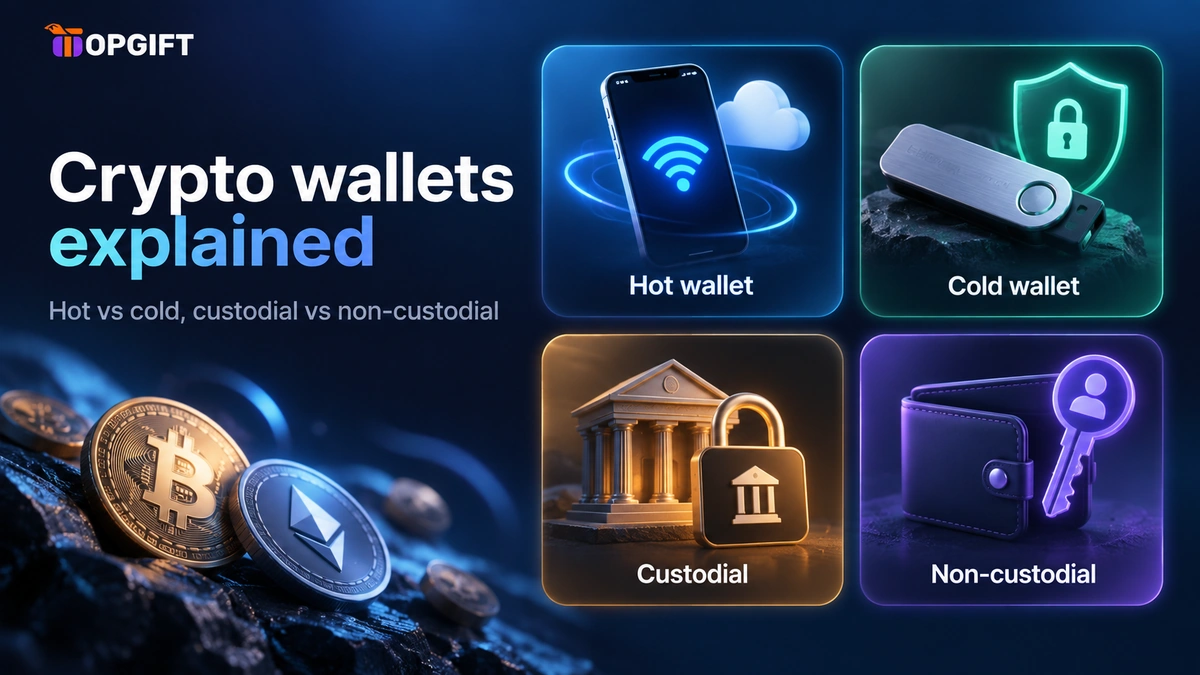
Ask ten crypto guides what wallet to use and you’ll get ten different answers, mostly because the question hides two separate decisions inside one word. A wallet can be hot or cold, and it can be custodial or non-custodial, and those two things aren’t the same choice at all. Mixing them up is exactly why the advice out there feels so contradictory.
This guide untangles both axes properly, shows you the four real combinations that result, and walks through the genuine trade-offs of each — not which one is “best”, because there isn’t one, but which one fits a given situation.
In this guide
What a Crypto Wallet Actually Is
A crypto wallet doesn’t store coins the way a physical wallet stores cash. What it actually holds is a private key: a piece of cryptographic data that proves ownership of whatever’s recorded on the blockchain at a given address. The coins themselves live on the blockchain, permanently. The wallet is simply what lets you prove they’re yours and authorise moving them.
That distinction matters more than it sounds. Because the key is the thing that matters, wallet security is really key security. Every question in this guide — hot or cold, custodial or non-custodial — comes back to one thing: where does that key live, and who controls it.
Hot Wallets and Cold Wallets
This first axis is about internet connection. A hot wallet is connected to the internet — an app on your phone, a browser extension, an account on an exchange. A cold wallet is not connected, or only connects briefly to sign a transaction — a hardware device, or even a private key written on paper and stored somewhere safe.
The trade-off follows directly from that. A hot wallet is convenient precisely because it’s always reachable: you can send, receive and trade in seconds. That same connectivity is also the attack surface. Anything connected to the internet can, in principle, be reached by something else on the internet — malware, a phishing site, a compromised app.
A cold wallet flips that. Because the key never touches an internet-connected device, remote attacks essentially can’t reach it. The cost is friction: moving funds takes more steps, and the device itself becomes something you can physically lose, damage or forget the PIN for.
| Aspect | Hot wallet | Cold wallet |
|---|---|---|
| Internet connection | Always connected | Offline, or briefly online to sign |
| Convenience | Instant access, easy to use daily | Extra steps for every transaction |
| Main risk | Remote hacking, malware, phishing | Physical loss, damage, forgotten access |
| Typical examples | Exchange account, mobile app, browser extension | Hardware wallet, paper key |
| Best suited to | Active trading, small everyday amounts | Long-term holdings, larger amounts |
Neither is safer in an absolute sense. A hot wallet with a small balance and good habits can be perfectly reasonable. A cold wallet stored carelessly, or with the recovery phrase photographed on a synced phone, defeats its own purpose entirely.
Custodial and Non-Custodial Wallets
The second axis is separate, and it answers a different question: who actually holds the private key. In a custodial wallet, a company holds it for you — most exchange accounts work this way. You log in with a password, and the platform manages the keys behind the scenes. In a non-custodial wallet, you hold the key yourself, usually represented as a recovery phrase of twelve or twenty-four words.
Custodial wallets trade control for convenience. Forget your password, and a support team can help you recover access, the same way a bank helps you recover a locked account. That safety net exists because the platform, not you, holds the underlying key.
Non-custodial wallets flip that trade entirely. You hold the key, which means you also hold complete responsibility for it. There’s a well-known phrase in crypto for this: not your keys, not your coins — meaning that with a custodial wallet, you’re ultimately trusting someone else’s system. With a non-custodial wallet, nobody can freeze, recover or reverse anything, including for you.
Custodial
- Password recovery if you forget access
- No recovery phrase to lose or misplace
- Familiar login experience, easy for beginners
- Support team to contact if something goes wrong
Non-Custodial
- You hold the keys, nobody else
- Works even if an exchange fails or freezes accounts
- No company to approve, delay or block a transfer
- Lose the recovery phrase and access is gone for good
Neither column is a verdict. Both are simply what each type actually gives you, and the right one depends entirely on how much responsibility you want to carry yourself.
Four Real Setups
Because the two axes are independent, they combine into four genuinely different setups, and most people use more than one without realising it.
| Setup | What it looks like | Typical use |
|---|---|---|
| Hot + Custodial | An exchange account you log into with a password | Buying, selling, active trading |
| Hot + Non-Custodial | A mobile or browser wallet app, keys on your device | Everyday spending, connecting to apps |
| Cold + Custodial | Rare — some institutions offer offline custody for clients | Large institutional holdings |
| Cold + Non-Custodial | A hardware wallet you own and control | Long-term storage, larger personal amounts |
Most beginners start in the top-left box without ever choosing to: they buy crypto on an exchange, and it simply stays there in a hot, custodial account. That’s not wrong, but it’s worth being a deliberate choice rather than a default you never examined. As balances grow, many people gradually move toward the bottom-right — a cold, non-custodial hardware wallet — for whatever they don’t need immediate access to.
Common Wallet Mistakes
A few mistakes account for the overwhelming majority of lost funds, and none of them involve exotic hacking.
Losing a recovery phrase is the most common, and the most final. With a non-custodial wallet, that phrase is the only backup that exists. No company holds a copy, and no support line can retrieve it. Writing it down once, on paper, and storing that paper somewhere safe and offline remains the standard advice for a reason — it simply works, unlike photographing it on a phone that could be lost, hacked or backed up somewhere you don’t control.
Phishing is the second, and it catches experienced users as often as beginners. A fake site or app that looks identical to a real wallet, asking you to “verify” your recovery phrase, is not a security check — it’s theft. No legitimate wallet or exchange ever asks for your recovery phrase, under any circumstance.
Sending to the wrong address is the third, and it’s unforgiving. Blockchain transactions can’t be reversed, so a single mistyped character sends funds somewhere nobody can retrieve. Double-checking an address, or sending a small test amount first for a large transfer, costs a minute and prevents an irreversible mistake.
Getting Your First Crypto Into a Wallet
Whichever setup you land on, the first step is the same for almost everyone: getting some crypto in the first place, usually through an exchange like Binance. That step has its own common obstacle — a bank card that gets declined, or a bank that blocks payments to exchanges outright.
A Binance Gift Card sidesteps that. You buy a prepaid code, redeem it on Binance, and the crypto lands in your exchange account — a hot, custodial wallet, at that point. From there, moving some or all of it to a wallet you control yourself, hot or cold, is a simple withdrawal. Our redemption walkthrough covers that first step in detail, and our guide to funding versus spot wallets explains what happens once the crypto is in your account.
Browse the full Binance Gift Card range to see the coins and amounts available.
Shop Binance Gift Cards →Which Setup Fits You
A few honest patterns cover most people.
If you’re new to crypto and holding a small amount, a hot custodial account — an ordinary exchange wallet — is a reasonable place to start. It’s simple, it’s recoverable, and the convenience matters more than the risk while the amount is small.
If you’re holding crypto for the long term, or the amount has grown enough that losing it would genuinely hurt, a cold non-custodial wallet is worth the extra friction. It’s the setup least exposed to remote attacks, and the one where nobody but you can move the funds.
If you use crypto actively — trading, connecting to apps, moving funds often — a hot non-custodial wallet strikes a middle ground. You keep control of the keys without the friction of a hardware device for every transaction.
Many people, in practice, end up using more than one: a custodial exchange account for buying and trading, and a separate non-custodial wallet, hot or cold, for whatever they’re holding onto. There’s nothing wrong with that. The two axes are independent for a reason.
Frequently Asked Questions
What is the difference between a hot wallet and a cold wallet?
A hot wallet is connected to the internet, which makes it convenient but exposed to remote attacks. A cold wallet stays offline, which removes that exposure at the cost of extra steps for every transaction.
What does custodial and non-custodial mean?
Custodial means a company holds your private keys for you, similar to a bank. Non-custodial means you hold the keys yourself, usually as a recovery phrase, with no company able to recover them if you lose access.
Which type of wallet is safest?
A cold, non-custodial wallet removes the most remote-attack risk, but it shifts all responsibility to you. Safety depends as much on habits — protecting your recovery phrase, avoiding phishing — as on which type you choose.
Can I use more than one wallet type?
Yes, and most active users do. A common pattern is a custodial exchange account for buying and trading, alongside a separate non-custodial wallet for longer-term holdings.
What happens if I lose my recovery phrase?
With a non-custodial wallet, access is gone permanently — there’s no company or support line that can restore it. This is exactly why writing it down and storing it safely matters so much.
How do I get crypto into a wallet without a bank card?
A Binance Gift Card lets you buy crypto with a prepaid code instead of a bank card, and the balance lands in your exchange account ready to use or move to a wallet of your own.