
Holding crypto and doing nothing with it is the default for most people — and it’s the one thing that guarantees your coins earn you nothing. Binance Earn exists to change that. It’s the part of Binance where your idle crypto can generate a return, through products that range from a flexible savings-style account you can leave at any time to longer commitments that pay more for locking funds up.
This guide explains how Binance Earn actually works, what the different products do, what kind of returns are realistic, and — just as important — what the risks are. It also covers the simplest way to get funds onto Binance to begin with, which for many people is a Binance Gift Card, since it needs no bank card. By the end you’ll know whether Binance Earn suits you and how to start if it does.
In this guide
- What Is Binance Earn
- The Main Binance Earn Products
- How to Start Earning on Binance
- How Much Can You Really Earn
- Why Stablecoins Suit Binance Earn
- The Risks, Honestly
- Simple Strategies for Passive Income
- Funding Binance Earn With a Gift Card
- Is Binance Earn Worth It in 2026
- Frequently Asked Questions
What Is Binance Earn
Binance Earn is the umbrella name for all of Binance’s yield products — the tools that let you put crypto to work rather than leave it sitting in a wallet. Instead of trading, which needs time, skill and nerve, Earn products let you deposit an asset and receive a return on it, with the platform handling the mechanics behind the scenes.
The concept is close to a savings account, and the comparison is useful as long as you don’t take it too far. Like a savings account, you deposit and earn a return. Unlike a bank account, there’s no deposit guarantee, returns vary, and the underlying asset can rise or fall in value. Binance Earn is where a lot of newcomers first encounter the idea of earning on crypto, precisely because it’s built to be approachable — a few taps rather than a DeFi rabbit hole.
The Main Binance Earn Products
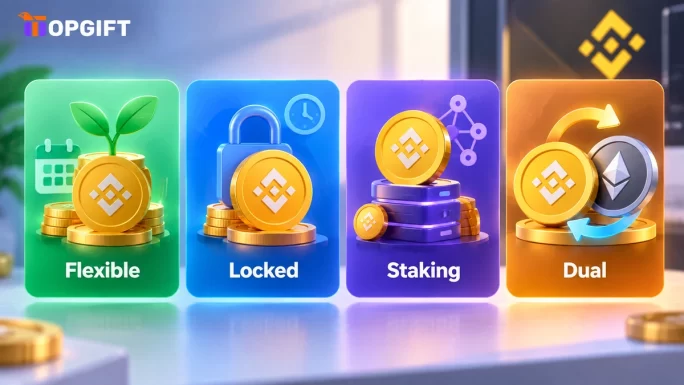
Binance Earn is not one product but a collection, and the differences between them matter a great deal. The broad split is between products that let you withdraw whenever you like and products that pay more in exchange for locking your funds for a period. Here’s the map.
| Product | What it is | Access to funds | Typical return | Best for |
|---|---|---|---|---|
| Simple Earn (Flexible) | Deposit and earn, withdraw any time | Any time | Lower | Beginners, keeping liquidity |
| Simple Earn (Locked) | Commit for a set term for a higher rate | End of term | Higher | Funds you won’t need soon |
| Staking | Support a blockchain network and earn its rewards | Varies by coin | Varies | Holders of proof-of-stake coins |
| Dual Investment | Structured product tied to a price target | At settlement | High, but variable | Experienced users only |
| Launchpool | Stake to earn new tokens | Flexible | Variable | Those wanting new-token exposure |
Simple Earn: Flexible and Locked
Simple Earn is the heart of Binance Earn and where most people start. It comes in two forms. Flexible lets you deposit an asset and withdraw it whenever you like, with a return that accrues while it’s there. It’s the gentlest option, ideal if you want your crypto to earn something without giving up access to it.
Locked pays a higher rate in exchange for committing your funds for a fixed term — commonly anywhere from a few weeks to a few months. You can’t touch the funds until the term ends (some products allow early redemption, but you forfeit the rewards). The trade is straightforward: more return for less flexibility. If you know you won’t need the money, Locked is the natural step up from Flexible.
Staking
Staking is specific to coins that run on proof-of-stake blockchains. When you stake, your coins help secure the network, and the network pays rewards for it. Binance handles the technical side, so for the user it feels much like Simple Earn — deposit, earn — but the return comes from the blockchain’s own reward mechanism rather than from lending. Ethereum staking is the best-known example, and Binance offers it in a form that doesn’t require running any hardware yourself.
Dual Investment and Advanced Products
Dual Investment is a structured product: you commit an asset against a target price and settlement date, and what you get back — and in which currency — depends on where the price lands. The potential returns are higher than Simple Earn, but the outcome isn’t fixed, and you can end up holding a different asset than you started with. It’s genuinely useful for people who understand it and a trap for those who don’t. Treat it as an advanced tool, not a starting point.
Launchpool and Learn and Earn
Launchpool lets you stake existing coins (often BNB or a stablecoin) to earn tokens from new projects listing on Binance — a way to get early exposure without buying. Learn and Earn is different again: complete short educational courses and quizzes, and receive small amounts of crypto as a reward. It won’t make you rich, but it’s a free way to pick up both knowledge and a little crypto.
How to Start Earning on Binance
Getting from zero to your first Earn deposit takes four steps, and none of them are hard.
- Create and verify a Binance account. Every regulated exchange requires identity verification, and Earn products aren’t available until it’s done.
- Fund your account. This is where people most often get stuck — bank cards get declined, banks block crypto merchants, and card minimums lock out small starts. The simplest route around all of it is a Binance Gift Card: you buy the card, redeem the code on Binance, and the crypto is credited to your account with no bank involved. There’s a full walkthrough in the redemption guide.
- Move funds to the right wallet. Redeemed funds usually arrive in the Funding Wallet. Earn products draw from your Spot Wallet, so transfer across — it’s free and instant. If that distinction is new to you, our post on the funding and spot wallets clears it up.
- Pick a product and subscribe. Open Binance Earn, choose the asset and product (start with Simple Earn Flexible), enter the amount, and confirm. Your return begins accruing.
How Much Can You Really Earn
This is the question everyone asks, and the honest answer has to come with a caveat: rates change constantly. What Binance Earn pays on a given asset this month may be different next month, driven by market demand, the asset itself, and which products are running promotions. Any specific percentage written here would be out of date by the time you read it, so instead here’s how to think about it.
As a general pattern, stablecoins in Flexible earn modest, steady returns — enough to beat leaving them idle, not enough to change your life. Locked products on the same coins pay noticeably more. Staking rewards on proof-of-stake coins vary widely by network. Promotional rates on newly listed assets can be very high for a short window and then fall sharply. The reliable move is to check the live rate inside Binance Earn before subscribing, and to treat any headline figure as “right now”, not “guaranteed”.
APR vs APY: What the Numbers Mean
Binance displays returns as APR or APY, and the difference trips people up. APR is the simple annual rate, without compounding. APY includes compounding — rewards earning their own rewards — so it comes out higher for the same underlying rate. When you compare products, make sure you’re comparing like with like. And remember both are annualised: a product showing a 5% APY pays roughly 5% over a full year, not per month. Over a few weeks, the return is a small fraction of that.
| Term | Includes compounding | Reads as |
|---|---|---|
| APR | No | Simple annual rate |
| APY | Yes | Effective annual rate, slightly higher |
Why Stablecoins Suit Binance Earn
There’s a reason stablecoins are the most popular thing people put into Binance Earn: they remove one whole category of risk. A stablecoin like USDC is designed to hold a steady value pegged to the dollar, so when you earn on it, you’re earning on something that isn’t swinging in price underneath you. The return is the return — not a return that a 20% price drop could wipe out overnight.
That makes USDC in Simple Earn one of the most sensible starting points there is. You get the “money working rather than sitting idle” benefit, priced in dollars, without the volatility that makes earning on Bitcoin or Ethereum a two-sided bet. For anyone who wants their first Earn deposit to be boring in the best sense, a stablecoin is the obvious pick. Our guide to stablecoins versus volatile coins goes deeper on that trade-off, and if you want to start with USDC specifically, a Binance Gift Card USDC redeems straight into it.
The Risks, Honestly
A good guide to Binance Earn has to be plain about what can go wrong, because “earn passive income” is exactly the phrase that gets people to skip this part.
- Price risk. If you earn on a volatile coin, the coin can fall in value by more than you earned. A 5% return on an asset that drops 30% is a loss. Stablecoins reduce this; they don’t remove every risk.
- Platform risk. Your returns come from Binance, not from thin air. Funds in Earn are subject to the platform’s own health and policies. Binance is large and established, but no platform is a bank with a deposit guarantee.
- Lock-up risk. Locked products mean you can’t access funds until the term ends. If you need the money, or the market moves and you want out, you’re stuck — or you forfeit the rewards to leave early.
- Rate risk. Rates are not fixed. A product paying well today can pay much less next week. Promotional rates in particular tend to fall.
- Depeg risk. Stablecoins are built to stay at a dollar, but “built to” isn’t “guaranteed to”. It’s rare, but stablecoins have briefly slipped from their peg.
- Product complexity. Dual Investment and other advanced products can return a different asset than you deposited. Misunderstanding them is a real way to lose money.
- Regional availability. Which Earn products you can use depends on where you are and local rules. Not everything is available everywhere.
None of this makes Binance Earn a bad idea. It makes it something to enter with your eyes open, with money you can afford to leave in, and — for a first deposit — in the simplest product available. This is general information, not financial advice.
Simple Strategies for Passive Income
You don’t need a complex plan. A few sensible approaches cover most people.
Start flexible, then decide. Put your first deposit in Simple Earn Flexible, ideally in a stablecoin. It earns from day one and you can withdraw whenever. Once you’re comfortable and know you won’t need the funds, move some into a Locked product for the higher rate.
Split between steady and growth. Keep a stablecoin position for reliable return, and if you hold coins you’re bullish on anyway, stake those rather than leaving them idle. That way the stable part earns predictably while the volatile part earns on top of whatever the price does.
Use auto-subscribe carefully. Binance can automatically roll your funds into new terms or new subscriptions. It saves effort, but check what it’s rolling into, since rates and terms change.
Keep it small at first. There’s no minimum worth worrying about — you can start with a very modest amount, learn how everything works, and scale up only when you understand it. Our note on buying crypto in small amounts is relevant here: a small first deposit costs you nothing in learning.

Funding Binance Earn With a Gift Card
The step that stops the most people isn’t choosing a product — it’s getting funds onto Binance in the first place. Bank cards get declined for crypto purchases, banks block the merchant category, fraud filters freeze payments, and card minimums shut out anyone wanting to start small. A Binance Gift Card removes all of that.
The mechanic is simple: you buy a Binance Gift Card, receive a code, and redeem it on Binance. The crypto is credited to your account, and from there it’s a free transfer into Earn. Because your bank only ever sees an ordinary digital purchase, none of the card-decline problems apply. Cards start at very small amounts, so you can fund a first Earn deposit for pocket change and grow from there. And if stablecoins are your starting point, a Binance Gift Card USDC lands directly in the asset you want to earn on.
It’s the route we’d suggest to anyone whose card has ever been refused, anyone who’d rather keep their bank out of it, or anyone who just wants the shortest path from “interested” to “earning”. Browse the full Binance Gift Card range, pick an amount, and you’re a redemption away from your first Earn deposit.
Browse Binance Gift Cards →Is Binance Earn Worth It in 2026
For most people with idle crypto, yes — with the right expectations. Binance Earn won’t make you rich; the returns are modest for steady products and only high where the risk is high too. What it does is turn crypto that would otherwise sit doing nothing into crypto that earns something, through products simple enough for a beginner to use in an afternoon.
The people it suits best are those who already hold crypto and want it working, who prefer a stablecoin’s steadiness over volatility, and who are willing to start small and learn. The people it suits least are those chasing high yields without understanding the products behind them. Approach it as a way to make holding more productive rather than a way to get rich, start with Simple Earn and a stablecoin, and it’s a genuinely useful tool.
Frequently Asked Questions
What is Binance Earn in simple terms?
It’s the section of Binance where you can deposit crypto and earn a return on it, instead of leaving it idle. Products range from flexible savings-style accounts to staking and longer locked terms.
What is the easiest Binance Earn product for a beginner?
Simple Earn Flexible, ideally with a stablecoin like USDC. It earns from day one, you can withdraw any time, and a stablecoin removes price swings from the picture.
How much can I earn on Binance Earn?
It varies by asset, product and market conditions, and rates change often. Stablecoins in Flexible earn modest steady returns; Locked and staking pay more. Always check the live rate in Binance before subscribing rather than relying on any quoted figure.
Is Binance Earn safe?
It’s a product from a large, established exchange, but it isn’t a bank account. Risks include price movement, rate changes, lock-up periods, platform risk and, for stablecoins, a rare depeg. Start small and in the simplest product.
What is the difference between APR and APY?
APR is the simple annual rate; APY includes compounding, so it reads slightly higher for the same underlying return. Both are annual figures, not monthly.
Can I start Binance Earn with a gift card?
Yes. Redeem a Binance Gift Card on Binance, transfer the funds from your Funding Wallet to your Spot Wallet, and subscribe to an Earn product. No bank card is needed at any point.
Can I withdraw from Binance Earn any time?
From Flexible products, yes. From Locked products, only at the end of the term — early redemption, where allowed, usually forfeits the rewards.