Buying a few dollars of crypto sounds harmless enough. The catch is that small purchases have an enemy nobody warns you about: fees. Spend $5 and lose $2 to charges, and you’ve handed over 40% before you’ve bought anything — a terrible deal hiding behind a small number.
So this guide is about buying crypto for small amounts without that quiet erosion. Which coins suit it, which traps to sidestep, and why the smallest purchases need the most thought, not the least.
Table of Contents
- The Hidden Enemy of Small Buys: Fees
- Why “Cheap Coins” Are a Trap
- What Actually Works Small
- The Gift Card Angle
- A Realistic Example
- Frequently Asked Questions
- Start Small
The Hidden Enemy of Small Buys: Fees
On a large purchase, fees are an annoyance. On a small one, they’re the whole story — because most fees are fixed or percentage-based amounts that don’t shrink just because your purchase did.
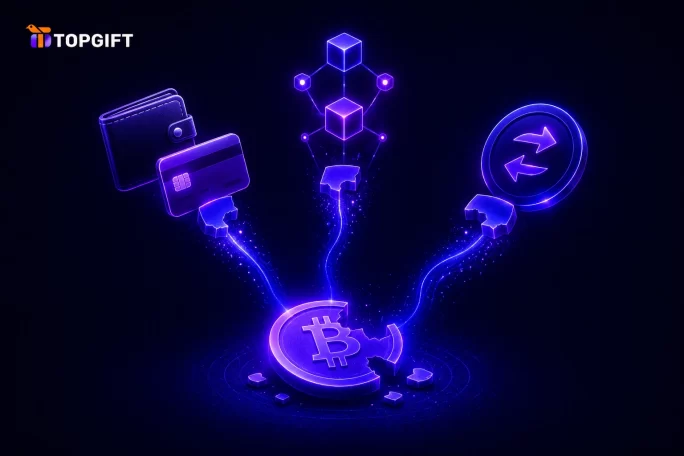
Three costs tend to bite:
- Purchase or deposit fees. Many exchanges charge a percentage on card purchases, and some add a flat minimum on top. On $5, a flat fee is brutal.
- Network fees. Moving crypto between wallets costs a network fee, and on some blockchains that fee can be a dollar or more regardless of how little you’re sending.
- The spread. The gap between the buy and sell price is effectively a hidden fee, and it doesn’t scale down with the size of your order.
Put together, these can quietly consume a huge share of a tiny purchase. The goal with small amounts isn’t finding the coin that’ll moon — it’s keeping fees from eating the buy alive.
Why “Cheap Coins” Are a Trap
Newcomers often reason like this: “I only have $5, so I should buy a coin that costs a few cents and get thousands of them.” It feels logical. It’s also the single most common beginner mistake in crypto.
The price per coin tells you nothing on its own. A coin worth $0.01 isn’t cheaper than one worth $50,000 — it just has more units in circulation. $5 buys $5 of value either way, whether that’s a sliver of one coin or thousands of another. You can own a fraction of Bitcoin just as easily as a pile of some micro-priced token.
Worse, chasing coins because they’re “cheap” usually steers people toward tiny, obscure, high-risk tokens — precisely the ones most likely to collapse. A low price tag is not a bargain. It’s often a warning.
What Actually Works Small
For a small purchase, the sensible priorities are low fees and something solid — not a lottery ticket.
A stablecoin is the calmest choice. If you’re buying small to learn how crypto works, USDC lets you practise moving and holding value without watching a few dollars swing around. Nothing to stress about while you find your feet.
An established coin, in fractions. You don’t need a whole Bitcoin. A few dollars buys a fraction of Bitcoin or Ethereum, and you get real exposure to a serious asset rather than a gamble on an unknown one.
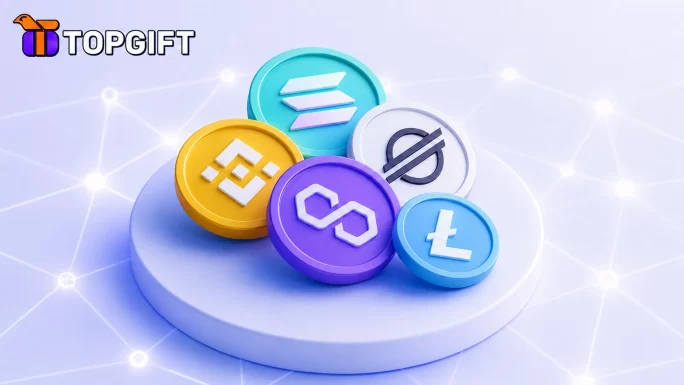
A low-fee network coin. If you actually plan to move the crypto, coins on cheap networks — like those built for fast, low-cost transfers — mean the network fee won’t dwarf the amount. Our guide to the best crypto to buy with a gift card breaks down which coins fit which goal.
The Gift Card Angle
Here’s where small purchases get genuinely awkward on a normal exchange: many won’t let you buy small at all. Card purchases often carry a minimum of $10 or $20, so a true “few dollars” experiment simply isn’t on the menu.
A gift card removes both problems at once. Cards start at $0.50, so there’s no minimum standing between you and a tiny purchase. And redemption carries no network fee — the credit lands inside the exchange rather than crossing a blockchain — so the single biggest tax on small buys disappears entirely.
For very small amounts, that fee saving isn’t a minor perk. It’s often the difference between a purchase that makes sense and one that doesn’t. There’s a fuller breakdown of the trade-offs in our comparison of gift cards versus buying on an exchange.
A Realistic Example
Say you want to put $5 into crypto, just to see how it all works.
The trap: you buy some coin priced at a fraction of a cent because $5 gets you “loads” of it, then later try to move it and lose most of the value to a network fee. You learn a lesson, but an expensive one.
The sensible version: you buy $5 of a stablecoin or a fraction of an established coin through a route with no minimum and no redemption fee. The full $5 arrives. You move it, hold it, and get the real experience of using crypto — which was the entire point of spending $5 rather than $500.
Small purchases are for learning and for low-stakes exposure. Treated that way, they’re one of the smartest ways to start. Treated as a hunt for the next thousand-times coin, they’re just a fast way to lose $5.
Frequently Asked Questions
What’s the smallest amount of crypto I can buy?
It depends where you buy. Exchanges often set card-purchase minimums around $10 to $20. A gift card has a far lower floor — from $0.50 — which makes genuinely small purchases possible.
Should I buy a cheap coin to get more of it?
No. The price per coin means nothing on its own — $5 buys $5 of value whether that’s a fraction of one coin or thousands of another. Chasing low-priced coins usually leads to riskier, more obscure tokens, not better value.
Why do fees matter so much on small purchases?
Because many fees are fixed or percentage-based and don’t shrink with your order. A flat fee that’s trivial on $500 can swallow a large chunk of $5, so keeping fees low matters far more at small sizes.
What’s the best crypto to buy with only a few dollars?
For learning, a stablecoin like USDC keeps things calm. For real exposure, a fraction of an established coin like Bitcoin or Ethereum. Avoid obscure micro-priced tokens picked purely because they seem cheap.
Do gift cards charge a network fee?
No. Redemption happens inside the exchange rather than on a blockchain, so no network fee applies. On small amounts, that saving is significant.
Is buying a small amount of crypto worth it?
As a way to learn or to take low-stakes exposure, yes. As a get-rich scheme, no — small amounts are best treated as tuition or experiment, using only money you can afford to lose.
Start Small
The smartest small purchase isn’t the one that might explode in value — it’s the one where fees don’t eat it and you learn something. Keep costs low, ignore the price-per-coin illusion, and treat the money as tuition rather than a bet.
Since cards start at $0.50 and redemption carries no network fee, the crypto range is a practical place to make a small purchase actually worth making.