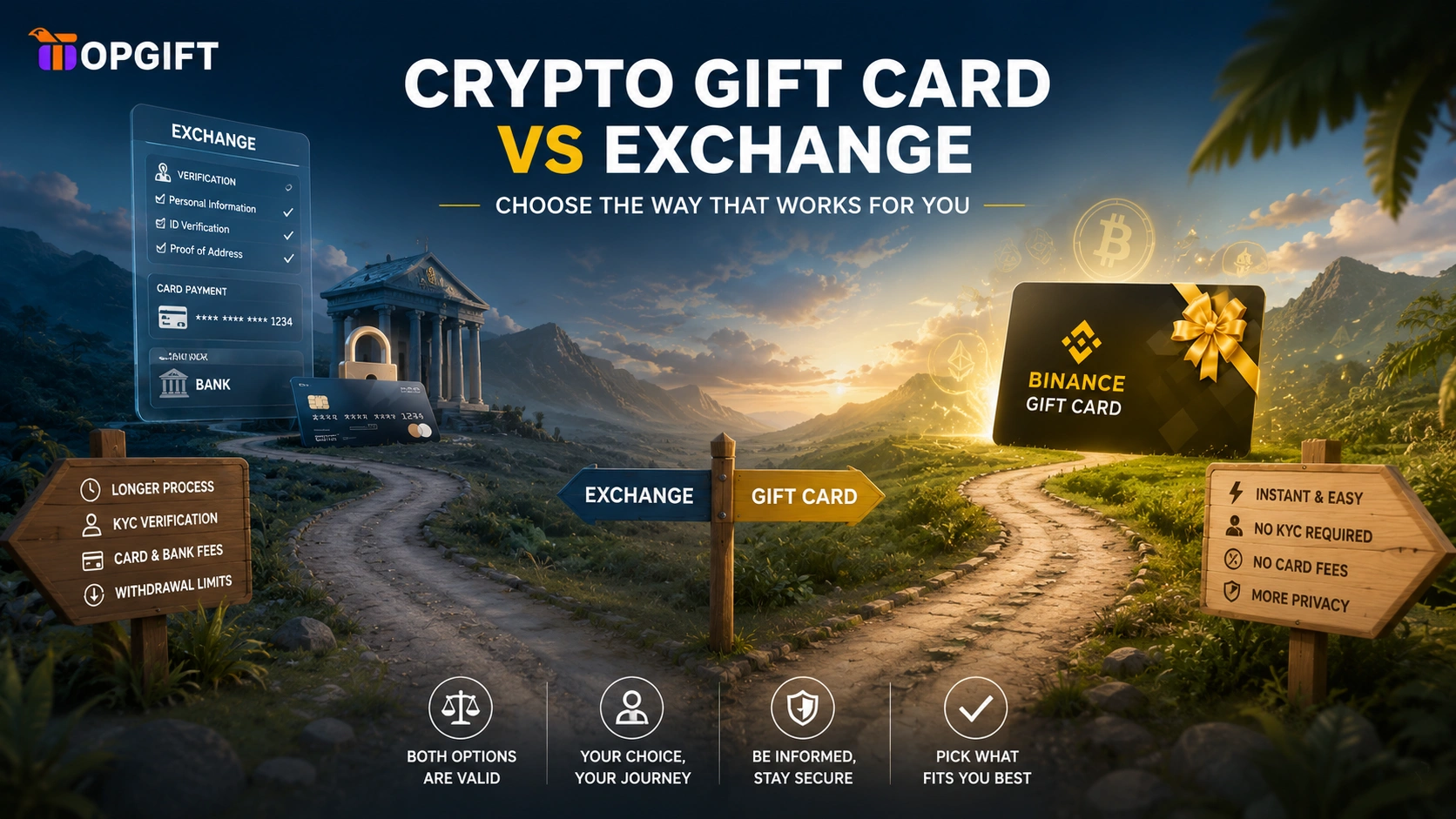
Both routes end the same way: crypto in your account. Yet they solve completely different problems along the way, and the right choice depends far more on your circumstances than on which one is objectively better.
So this comparison covers what each route actually demands of you, what each one costs, and — because it matters — the situations where buying crypto with a gift card makes no sense at all.
Table of Contents
- The Short Version
- What Buying Directly Involves
- What the Gift Card Route Involves
- The Cost Difference, Honestly
- When the Exchange Wins
- When a Gift Card Wins
- Frequently Asked Questions
- Where to Start
The Short Version
| Gift card | Direct on an exchange | |
|---|---|---|
| Bank card needed | No | Yes, usually |
| Risk of a declined payment | Low | Common with crypto merchants |
| Cost | Small premium | Cheaper |
| Account verification | Needed to redeem | Needed to buy |
| Can you give it to someone? | Yes | Not really |
| Smallest sensible purchase | Under a dollar | Often $10–20 |
| Shows on your bank statement | As a digital purchase | As a crypto purchase |
What Buying Directly Involves
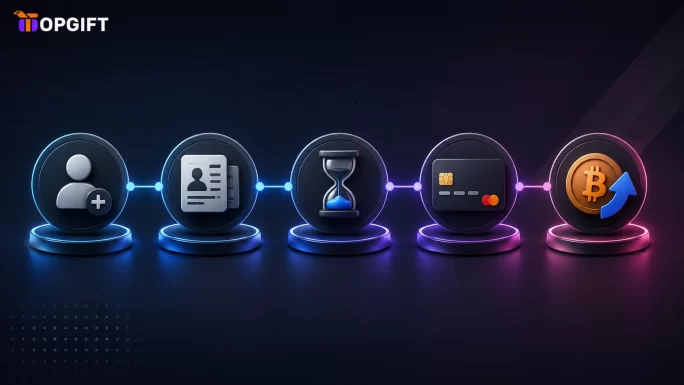
The direct route looks simple on paper. You open an exchange account, verify your identity, add a payment method, and buy. In practice each of those steps has a failure mode.
Verification takes time. Exchanges require identity documents, and approval ranges from minutes to several days depending on backlog and where you live.
Cards get refused. This one surprises people most. Banks routinely block payments to crypto merchants — sometimes as policy, sometimes through an automated fraud filter that nobody at the bank can explain or override. Retrying rarely helps, and the refusal comes without a reason.
Your bank sees everything. A direct purchase appears on your statement as exactly what it is. Some people don’t mind. Others do, particularly where banks have grown twitchy about crypto activity on personal accounts.
Minimums apply. Card purchases on most exchanges start around $10 to $20, so a genuinely small first experiment often isn’t available.
None of this makes the direct route bad. When your card works and your account is already verified, it’s the cheapest and most straightforward option available.
What the Gift Card Route Involves
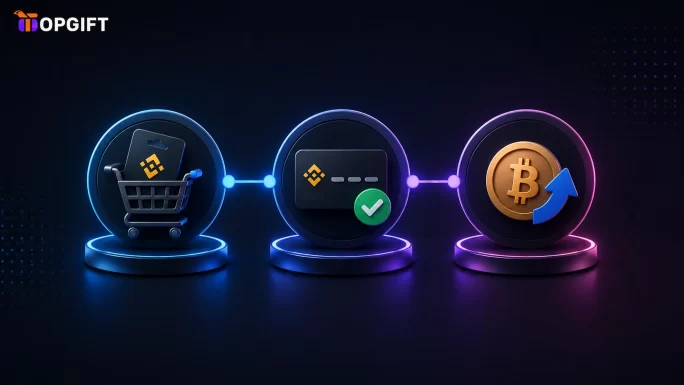
A gift card moves the payment step somewhere else entirely. Rather than paying the exchange, you buy a prepaid code from a merchant, then redeem that code into your account.
Consequently the bank never sees a crypto transaction — it sees an ordinary digital purchase, which is why the decline problem largely disappears. Payment methods open up too: card, PayPal, Apple Pay, Google Pay and crypto itself all work, whereas exchanges typically accept a much narrower list.
Two conditions still apply, though, and neither gets mentioned often enough. First, redemption requires a verified Binance account, so the identity check hasn’t vanished — it has simply moved to a later step. Second, codes expire six months after creation, which rules out buying one to hold indefinitely.
Redemption itself takes under a minute, and our step-by-step redemption guide walks through both the app and the desktop route.
The Cost Difference, Honestly
Gift cards cost more than buying at spot price. Anyone claiming otherwise is selling something.
The premium covers what sits behind the code: payment processing across a dozen methods, instant delivery, and a merchant carrying the risk of chargebacks. That’s a real service, but it isn’t free, and pretending otherwise would be silly.
Whether the premium matters depends entirely on scale. On a small purchase it amounts to pocket change — often less than the network fee you’d pay moving crypto between wallets afterwards. On a large one it becomes a meaningful number, and at that point the direct route deserves serious consideration.
Worth factoring in on the other side: redeeming a gift card carries no network fee at all, because the credit happens inside the exchange rather than on a blockchain. On small amounts that saving offsets a decent chunk of the premium.
When the Exchange Wins
Skip the gift card entirely if any of these describe you.
- Your card already works. Verified account, payments going through, no drama — then you’re paying a premium to solve a problem you don’t have.
- You’re buying a large amount. The premium scales with the purchase, and past a certain point it stops being trivial.
- You trade actively. Frequent buying means frequent premiums. Fund the account directly instead.
- You want the absolute lowest cost. Direct purchase wins on price. Every time.
When a Gift Card Wins
The gift card route earns its premium in these situations.
- Your card keeps getting declined. The most common reason people end up here, and the problem a gift card genuinely solves rather than works around.
- You’d rather your bank stayed out of it. Not everyone wants crypto purchases itemised on a statement their bank reviews.
- You’re giving crypto to someone. Sending coins normally requires the recipient’s wallet address, which requires them to have a wallet already. A code requires neither.
- You want to start very small. Cards run from $0.50, so testing the process costs almost nothing.
- Your preferred payment method isn’t accepted. PayPal and Apple Pay rarely work directly on exchanges. They work fine here.
- Someone else is buying on your behalf. A parent, a friend, an employer — none of them need access to your exchange account.
Frequently Asked Questions
Is buying crypto with a gift card more expensive?
Yes, slightly. The code carries a premium over spot price, which covers payment processing and instant delivery. On small purchases the difference is minor, especially since redemption avoids network fees. On large purchases it grows, and buying directly usually makes more sense.
Do I still need to verify my identity?
Yes. Redeeming requires a verified exchange account, so verification happens at redemption rather than at purchase. Nobody avoids it entirely.
Why do banks decline crypto purchases?
Some banks block crypto merchants by policy. Others rely on automated fraud filters that flag the transaction type. Either way the refusal usually arrives without explanation, and retrying seldom changes the outcome.
Can I give a gift card to someone else?
Yes, and that’s one of its genuine advantages. Pass the code along and the recipient redeems it into their own account. No wallet address changes hands, and neither of you needs the other’s account details.
Do gift cards expire?
Binance Gift Cards remain valid for six months from creation. Buy one when you plan to use it rather than well ahead of time.
Which route is faster?
A gift card, if you’re starting from nothing — no bank linking and no waiting on a card payment to clear. However, if your exchange account is already set up and funded, buying directly takes seconds.
Does redeeming cost a network fee?
No. The credit happens inside the exchange rather than on a blockchain, so nothing gets deducted. Your full value arrives.
Where to Start
If the direct route works for you, use it — it’s cheaper, and no amount of marketing changes that. Should your card keep failing, though, or should you want to hand crypto to someone without a wallet, a prepaid code solves those problems directly rather than working around them.
TopGift appears in Binance’s own merchant directory, so our codes redeem straight through Binance. Values start at $0.50 and run to $200 across more than fifty coins.
Take a look at the full crypto range to see what’s available.