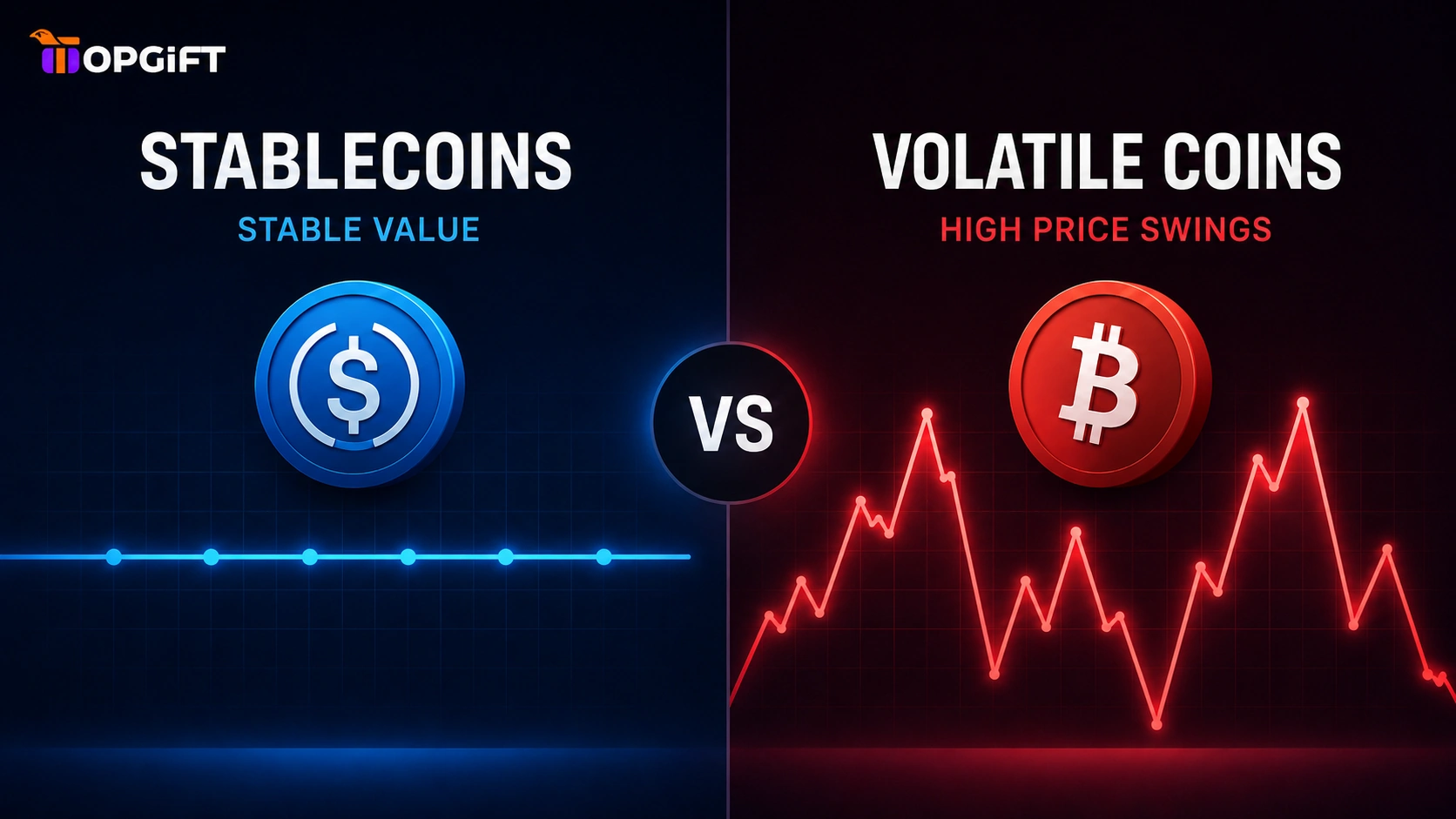
When you first look at crypto, it seems like one big confusing category. It isn’t. There’s a clean split running through the middle of it — coins designed to hold still, and coins designed to move. Understanding that split is the single most useful thing a beginner can do before buying anything.
This guide explains the difference between stablecoins and volatile coins in plain terms, and helps you decide which makes more sense as your first purchase. The honest answer, as usual, depends on what you actually want.
Table of Contents
- The Two Kinds of Crypto
- What a Stablecoin Actually Is
- What “Volatile” Really Means
- Which Should You Buy First?
- You Don’t Have to Choose Just One
- Frequently Asked Questions
- Making Your First Move
The Two Kinds of Crypto
Almost every coin you’ll come across falls into one of two camps, and they exist for opposite reasons.
Stablecoins are built to hold a fixed value — usually one US dollar. Their entire job is to not move. They’re the calm end of crypto.
Volatile coins are everything else: Bitcoin, Ethereum, and the thousands of others whose prices rise and fall, sometimes dramatically. This is the end most people picture when they think of crypto.
Neither is better in the abstract. A stablecoin is useless if you’re hoping the price climbs, and a volatile coin is nerve-wracking if you just wanted somewhere steady to park value. They’re tools for different jobs, and the “right” first coin is the one that matches yours.
What a Stablecoin Actually Is
A stablecoin is a cryptocurrency pinned to the value of something stable — nearly always the US dollar. One USDC is designed to always be worth about one dollar, and it’s backed by real reserves held to make that peg hold.
The point of a stablecoin isn’t growth. It’s stability, which sounds dull until you realise how useful it is. It lets you hold value on-chain without the stress of watching it swing, move money quickly and cheaply, or step out of a volatile position without cashing all the way back to a bank.
For a nervous beginner, a stablecoin is the gentlest possible introduction. You can buy some, move it around, get comfortable with wallets and redemption, and nothing scary happens to the number while you learn.

What “Volatile” Really Means
Volatile simply means the price moves, and in crypto it can move a lot. A volatile coin might rise 20% in a week, or fall just as far, and neither would be unusual. That’s the trade-off baked into the whole asset class: the potential upside people chase and the downside that comes attached to it.
This is what makes volatile coins exciting and risky in equal measure. Bitcoin and Ethereum are the largest and most established, so they tend to swing less wildly than tiny obscure tokens — but “less wildly” is relative. All of them can and do fall hard.
The rule that matters here is old but true: only put in what you can afford to lose. Volatile crypto can reward patience, but it owes you nothing, and treating it as guaranteed growth is how beginners get hurt. This article is general information, not financial advice.

Which Should You Buy First?
Match the choice to your reason for being here.
Buy a stablecoin first if you mainly want to learn how crypto works, hold steady value, or move money — without watching a price chart with your stomach in knots. It’s the low-stress way in.
Buy a volatile coin first if you’re here for exposure to the market — you want a stake in Bitcoin or Ethereum and you accept the ride that comes with it. Just size it as money you’re prepared to lose, especially the first time.
If you’re genuinely unsure, a stablecoin is the more forgiving starting point, because the worst that happens while you find your feet is very little. Our guide to the best crypto to buy with a gift card maps specific coins to specific goals if you want to go further.
You Don’t Have to Choose Just One
The question is framed as “which first”, but nothing stops you buying a little of each — and for a beginner, that’s often the smartest move of all.
A small amount of a stablecoin teaches you the mechanics safely. A small amount of a volatile coin gives you real skin in the game and a reason to pay attention. Between them you learn both halves of crypto without betting much on either. Since purchases can start from $0.50, splitting a tiny budget across both costs almost nothing — there’s more on that in our guide to buying crypto in small amounts.
Frequently Asked Questions
What’s the difference between a stablecoin and Bitcoin?
A stablecoin like USDC is designed to hold a fixed value, usually one US dollar. Bitcoin is volatile — its price rises and falls, sometimes sharply. One is built to stay still, the other to move.
Which is safer for a beginner?
A stablecoin is the lower-stress starting point, because its value doesn’t swing while you learn. A volatile coin carries more risk but also the potential for gains. Safety depends on what you want and how much you can afford to lose.
Can a stablecoin lose value?
It’s designed not to, and a well-reserved stablecoin holds its peg in normal conditions. Nothing in crypto is entirely without risk, but a stablecoin’s whole purpose is to avoid the swings volatile coins have.
Should I buy Bitcoin or a stablecoin first?
If you want to learn calmly or hold steady value, start with a stablecoin. If you want market exposure and accept the risk, start with an established volatile coin like Bitcoin. Or buy a little of each.
Why would anyone buy a coin that doesn’t go up?
Because stability is useful on its own. Stablecoins let you hold and move value without volatility, park funds between trades, or simply learn the ropes without watching the price. Growth isn’t the goal.
How much should I start with?
As little as you like — purchases can start from $0.50. Treat a first buy as a way to learn rather than an investment, and only use money you can afford to lose.
Making Your First Move
The choice isn’t really stablecoin versus volatile — it’s knowing which one answers the reason you came. Want calm and learning? Stablecoin. Want market exposure and can stomach the swings? A volatile coin. Want both lessons at once? A bit of each.
Since purchases start at $0.50 across both kinds, our Binance Gift Cards are an easy place to make whichever first move suits you.