Set up any self-custody crypto wallet and it hands you a list of words. Twelve of them, sometimes twenty-four. The screen tells you to write them down and keep them safe, then moves on as if that were obvious. It isn’t. Those words are the single most important thing about your wallet, and most people store them badly.
This guide explains what a seed phrase really is, where to keep it, and the mistakes that quietly cost people everything they hold. It pairs with our guide to crypto wallets, which covers the wallet types themselves.
In this guide
What a Seed Phrase Actually Is
A seed phrase, also called a recovery phrase, is a human-readable version of your wallet’s master key. The words come from a fixed list of 2,048 English words, defined by a standard most wallets follow. That is why the words always look ordinary, and why the same phrase works across many different wallet apps and devices.
From those words, your wallet mathematically derives every private key it holds. Not just one address, but all of them, across every network the wallet supports. This is why a single phrase can restore an entire wallet with dozens of addresses on it.
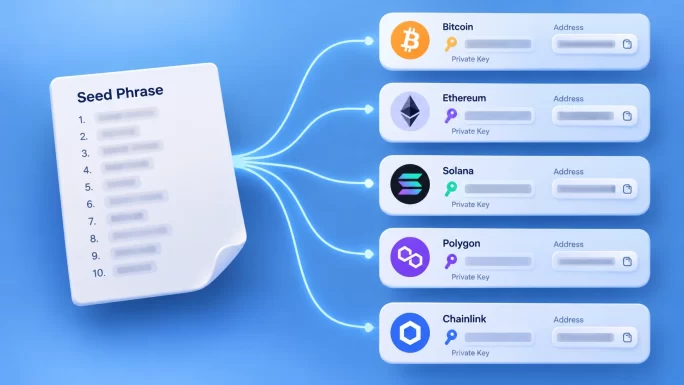
Order matters completely. The same twelve words in a different sequence produce a different wallet. There is no partial credit and no recovery from an almost-correct phrase.
What It Is Not
A seed phrase is not a password, and treating it like one causes most of the damage.
A password protects access to an account on someone’s server. If you lose it, support resets it. A seed phrase isn’t stored on anyone’s server. Nobody holds a copy, nobody can reset it, and nobody can help you if it’s gone.
It is also not something you ever need to type into a website, an app you didn’t set up yourself, or a form. Your wallet asks for it exactly twice in its life: when you first back it up, and if you ever restore it. Any other request is an attempt to steal it.
Finally, it is not just a backup. Anyone holding those words has your crypto, immediately and irreversibly. The phrase doesn’t unlock your wallet. The phrase is your wallet.
Where to Store It
The goal is storage that survives both disasters and other people. Those two threats pull in opposite directions, which is what makes this genuinely hard. A copy hidden so well you might lose it is as dangerous as a copy someone else might find.
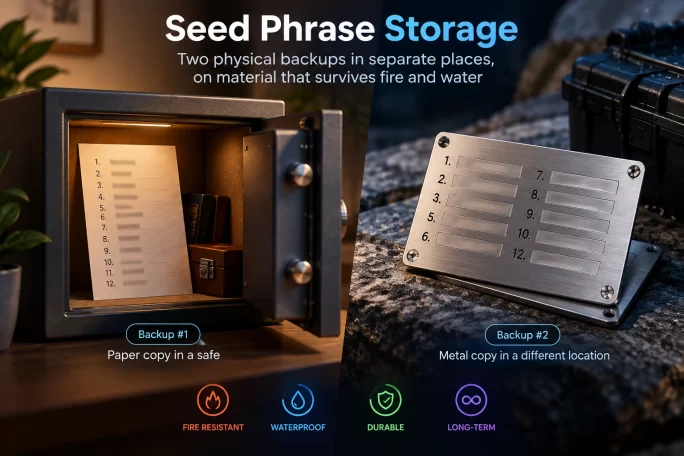
Most people should aim for two physical copies, in two separate places, on material that survives water and fire. Anything beyond that depends on how much you hold and who else lives in your home.
| Method | Holds up against | Weak point |
|---|---|---|
| Paper at home | Hacking, remote attacks | Fire, water, being found |
| Metal backup plate | Fire, water, time | Costs more, still findable |
| Two copies, two places | A single disaster or theft | Two places to keep secure |
| Bank safe deposit box | Theft and household risks | Access hours, access rights |
| Photo or cloud note | Nothing | One account breach loses everything |
Splitting a phrase across locations sounds clever, but it deserves a warning. Storing six words here and six words there means losing either half loses everything, and a partial phrase makes an attacker’s job easier rather than impossible. Some hardware wallets support a proper scheme for splitting a backup into shares, where any two of three recover the wallet. That is a real solution. Tearing the paper in half is not.
The Mistakes That Lose Coins
Almost every loss traces back to one of a handful of habits.
Photographing the phrase is the most common. A photo goes straight to cloud backup, which means it now sits on a server, protected only by the password to your email or photo account. The same applies to a screenshot, a note in your phone, or a message to yourself.
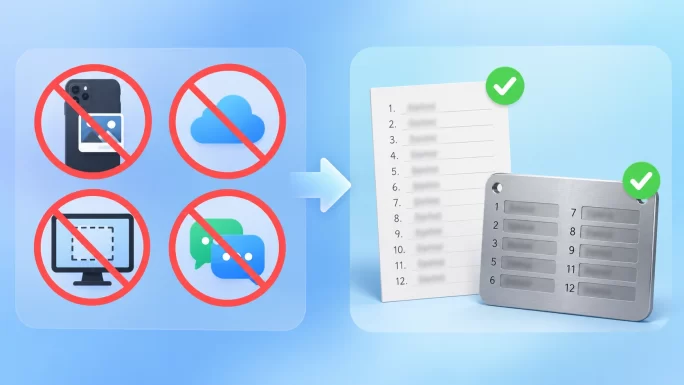
Typing it into anything is the second. Password managers feel safe, but a phrase in a password manager is only as secure as that account, and it is now digital rather than physical. Wallet-drainer sites exist for exactly this reason, and some of them look identical to the wallet you actually use.
Trusting a “support agent” is the third, and it catches experienced users. Nobody from a wallet, an exchange or a blockchain project will ever ask for your phrase. Anyone who does is stealing from you, regardless of how helpful they have been for the past twenty minutes. Our guide to scam tactics covers the same pressure patterns in another setting.
The last one is quieter: never writing it down properly in the first place. A phrase scribbled on a receipt in a drawer, or half-remembered from setup day, is not a backup. It is a coin flip.
Testing Your Backup
Here is the uncomfortable truth about backups. Most people find out theirs is wrong at the exact moment they need it, which is the worst possible time.
A single miswritten word, two words swapped, or an unreadable letter is enough to make a phrase useless. So test it while everything still works, and while a mistake costs you nothing.
One rule matters above all here. Never wipe your only device to test a backup. If the phrase turns out to be wrong, you have just destroyed the working copy of your wallet.
- Read your written phrase out loud from the backup itself, not from memory, and check every word against the wallet’s word list.
- Use a second device or a spare wallet app — never the device your funds live on.
- Restore from your written copy and compare the first receiving address with the one in your main wallet.
- Remove the test wallet from that second device once the addresses match.
The Extra Word Some Wallets Offer
Many wallets support an optional extra, usually called a passphrase, and sometimes described as a twenty-fifth word. You choose it yourself, and it is never part of the written phrase.
The effect is that the seed phrase alone no longer opens the wallet. Someone who finds your written words gets nothing without the passphrase, which makes it genuinely powerful protection for a backup stored somewhere less than perfect.
It cuts both ways, though. There is no recovery if you forget it. A seed phrase plus a forgotten passphrase is as useless as no backup at all, and plenty of people have lost funds this way. If you use one, store it as carefully as the phrase itself, and separately from it.
Planning for the Worst
This part gets skipped almost universally, and it becomes a real problem for families. If something happens to you, your crypto is only recoverable by someone who can find and use the phrase.
Exchanges have processes for inheritance, because a company holds the account. Self-custody has nothing of the kind. No form, no helpline, no legal process reaches funds whose keys are gone.
Handling this doesn’t mean handing the phrase to relatives today. It usually means leaving clear sealed instructions that explain what exists and where the backup is, stored with a will or a lawyer, so the right person can act without the information being readable in the meantime.
If Someone Has Seen It
If your phrase has been photographed, typed into a suspicious site, or seen by someone you don’t trust, treat the wallet as compromised. There is no way to change a seed phrase, and no way to revoke it.
The only fix is to move. Create a brand-new wallet, back up its new phrase properly, and transfer every asset across. Do it promptly, because anyone holding the old phrase can empty the wallet at any moment.
Check every network the old wallet held funds on, not only the obvious one. Assets on a second or third network are easy to forget, and they stay exposed until they are moved.
Frequently Asked Questions
What is a seed phrase?
It is a list of 12 or 24 words that represents your wallet’s master key. From it, your wallet derives every private key and address it holds, which is why it can restore a whole wallet on a new device.
Can I change my seed phrase?
No. A phrase can’t be changed or revoked. If it has been exposed, the only fix is to create a new wallet and move your funds to it.
Is it safe to store a seed phrase in a password manager?
It is far weaker than a physical backup. Doing so turns a physical secret into a digital one, and its safety then depends entirely on that account’s security.
What happens if I lose my seed phrase?
If you still have access to your wallet, back the phrase up again immediately, or move the funds to a new wallet with a fresh phrase. If you have lost both the phrase and access, the funds cannot be recovered by anyone.
Does anyone ever legitimately need my seed phrase?
No. Not a wallet developer, not an exchange, not a support agent, not a project giving away tokens. Every single request is an attempt to steal your crypto.
Should I use 12 or 24 words?
Either is secure in practice. A 24-word phrase offers more theoretical security, while a 12-word phrase is easier to record accurately, and recording it accurately is where most people actually fail.
🔑 Key takeaways
- The phrase isn’t a password to your wallet — it is the wallet. Anyone holding it holds your crypto.
- Two physical copies, in two places, on fire- and water-resistant material is the sensible baseline.
- Never photograph it, store it in the cloud, or type it anywhere except your own wallet.
- Test the backup on a second device while everything still works — never by wiping your only one.
- If it has been exposed, move everything to a brand-new wallet straight away.