Solana is one of the fastest blockchains around, and its coin, SOL, regularly ranks among the biggest cryptocurrencies. It’s also about to get its largest upgrade yet. So what is Solana, and why do so many people use it for cheap, quick transactions?
This guide explains how Solana works, where it came from and what its October 2026 upgrade changes. It also compares the network with Ethereum, shows how to get the SOL coin with a gift card and covers the risks to know before you buy.
Solana is a fast, low-cost blockchain, and SOL is its native coin. You use SOL to pay transaction fees, to stake and earn rewards, and to use apps on the network. Fees are usually a fraction of a cent, and the Alpenglow upgrade on October 21, 2026, aims to confirm transactions in about 150 milliseconds. You can get SOL without a bank card by redeeming a Binance Gift Card SOL.
What Is Solana
Solana is a public blockchain built for speed. Like Ethereum, it runs smart contracts, so developers can build apps for payments, trading, games and more on top of it. The difference is its focus on handling lots of transactions quickly and cheaply.
SOL is the coin that keeps the network running. Every transaction pays a small fee in SOL, and holders can stake their coins to help secure the network in return for rewards.
SOL coin at a glance
Today, Solana is one of the most used networks for stablecoin payments, trading and new token launches. It’s also home to a large share of the “memecoin” activity of recent years.
A Short History of Solana
The network has had a fast and sometimes bumpy ride. Here are the key moments:
2017Anatoly Yakovenko publishes the Solana whitepaper and introduces Proof of History.
March 2020Solana’s mainnet beta goes live.
2021 to 2022Fast growth, but also several network outages that halted transactions.
November 2022The collapse of the FTX exchange, a major Solana backer, sends SOL sharply lower.
January 2025SOL reaches its all-time high of around $294.
October 2025The first US spot Solana ETFs start trading.
October 21, 2026The Alpenglow upgrade replaces Solana’s original consensus system.
In other words, it went from a promising newcomer to a major network, survived some serious setbacks and is now rebuilding its core.
How Solana Works
Most blockchains spend a lot of time agreeing on the order of transactions. Solana speeds this up with Proof of History, a kind of built-in clock that timestamps events before validators vote on them. That lets the network process transactions in parallel and produce new blocks very quickly.
On top of that, the network uses Proof of Stake. Validators lock up SOL to take part, and other holders can delegate their coins to them. At the moment, holders stake around three quarters of all circulating SOL and earn a nominal yield of about 5% per year before validator fees.
Unlike Bitcoin, the SOL coin has no fixed supply cap. The network pays out new coins as staking rewards at an inflation rate of about 3.6% a year. That rate falls by 15% every year until it reaches 1.5%.
The Alpenglow Upgrade Explained
On October 21, 2026, at around 14:50 UTC, the network switches to Alpenglow, the biggest change to the network since its launch. It replaces TowerBFT, the voting system used since launch, with a new one called Votor.
The main goal is speed. Today, a transaction becomes final after about 12.8 seconds. With Alpenglow, the target is about 150 milliseconds, so payments feel almost instant. The network has also already cut its block time from 400 to 200 milliseconds.
For regular users, nothing changes in practice. Wallets and apps keep working, and you don’t need to move or swap your SOL. Transactions may pause briefly while the network switches over, but the handover should take only a moment.
ImportantScammers love big upgrades. Any message asking you to “migrate” or “upgrade” your SOL, or to connect your wallet for Alpenglow, is a scam.
Ethereum is working on a similar speed upgrade of its own. Our news on the Ethereum Glamsterdam upgrade explains what’s changing there.
Solana vs Ethereum
Solana and Ethereum are the two biggest smart contract networks, but they make different trade-offs:
Solana
Native coinSOL
Typical feesA fraction of a cent
Finality after upgradeAbout 150 ms (Alpenglow)
Stablecoins on the networkAbout $15.5 billion
Track recordSeveral outages in the past
Ethereum
Native coinETH
Typical feesHigher, especially when busy
Finality after upgradeMinutes on the main layer
Stablecoins on the networkAbout $144 billion
Track recordVery few interruptions
In short, Solana wins on speed and cost, while Ethereum leads on size, history and the amount of money on the network. Many people use both, depending on what they need.
What the SOL Coin Is Used For
SOL has several everyday uses:
- Paying fees: every transfer, swap or app action on Solana costs a small amount of SOL.
- Staking: you can stake SOL to help secure the network and earn rewards.
- Using apps: Solana hosts exchanges, NFT markets, games and payment apps.
- Holding stablecoins: many people use Solana to send dollar stablecoins quickly and cheaply, with SOL covering the fees.
On Binance, you can also hold SOL in Simple Earn to collect rewards. Our guide to Binance Earn explains how that works.
How to Get SOL With a Binance Gift Card
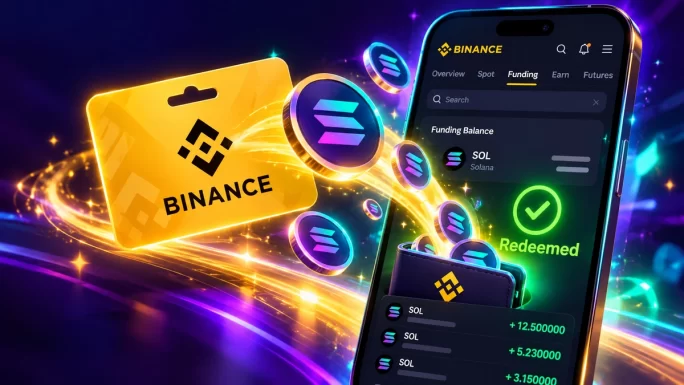
The simplest way to get SOL without linking a bank card is a Binance Gift Card SOL. It’s a code that loads SOL straight into your Binance account:
The card comes in small amounts, so it’s easy to start with a little SOL first. If you later want to move it to your own wallet, choose the Solana network when you withdraw, as our guide on how to withdraw crypto from Binance explains.
Solana on Binance
Binance Gift Card SOL
Redeem the code in the Binance app and the SOL lands in your Funding wallet. Small amounts available.
Buy Binance Gift Card SOLRisks to Know Before You Buy SOL
SOL is popular, but it isn’t risk-free. Keep these points in mind:
- Price swings: in mid-October 2026, SOL trades around $105, well below its 2025 high of about $294.
- Network outages: Solana has stopped processing transactions several times in the past, although it has been more stable recently.
- Ongoing inflation: there’s no supply cap, and the network mints new coins every year as staking rewards.
- Upgrade risk: developers test big changes like Alpenglow carefully, but they still carry some technical risk.
This guide is for learning only and isn’t financial advice. Only put in what you can afford to lose, and decide for yourself which coins to hold.
Frequently Asked Questions
Solana is a fast, low-cost public blockchain that runs smart contracts and apps. Its native coin, SOL, pays transaction fees and can be staked. The mainnet launched in March 2020 and is one of the largest crypto networks today.
SOL pays for transactions on the Solana network, can be staked to earn rewards and powers apps such as exchanges, games and payment services. Many people also use Solana to send stablecoins cheaply, with SOL covering the fees.
Alpenglow is Solana’s biggest upgrade, scheduled for October 21, 2026. It replaces the network’s original voting system and aims to cut the time until a transaction is final from about 12.8 seconds to about 150 milliseconds.
No. Your SOL stays where it is, and wallets and apps keep working. You don’t need to migrate, swap or upgrade anything. Any message asking you to do so is a scam.
Neither is simply better. Solana is faster and cheaper to use, while Ethereum is larger, older and holds far more stablecoins and other assets. Many people use both, depending on the app and the cost.
Yes. A Binance Gift Card SOL loads SOL straight into your Binance account. Redeem the code in the app under Gift Card, then Redeem, and the SOL appears in your Funding wallet within seconds.
Key Takeaways