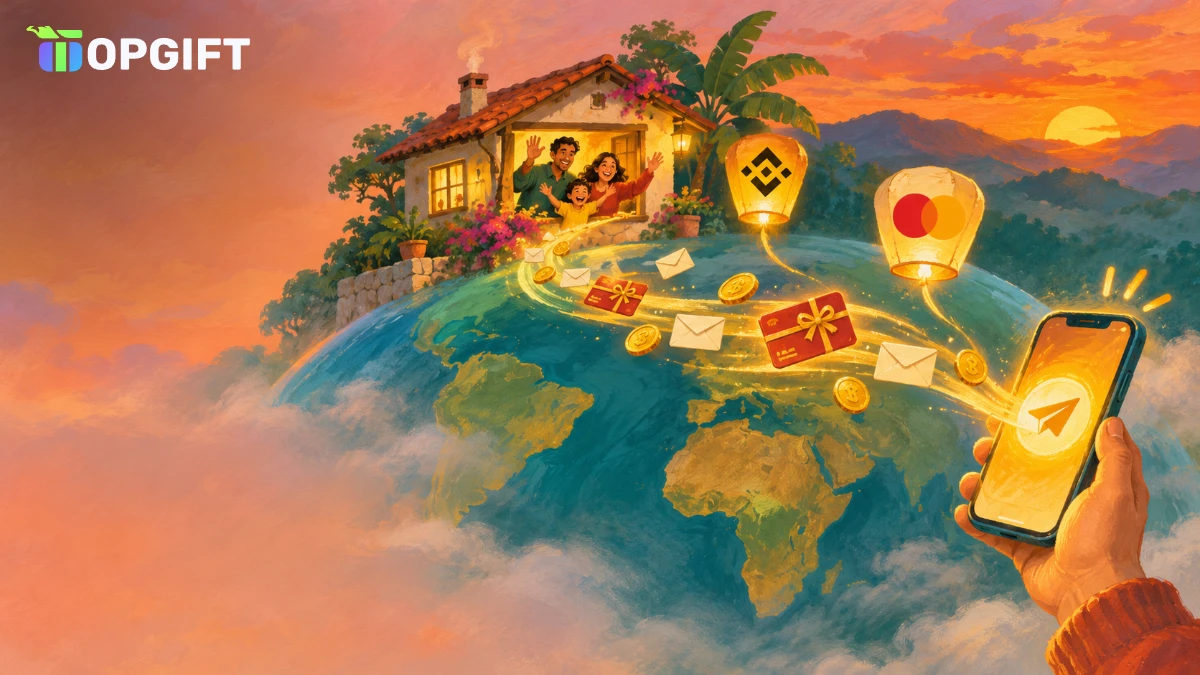
Millions of people send money to family abroad every month, but not everyone has a bank account, and bank transfers are often slow and expensive. The good news is that you have several other options, from cash pickup and mobile wallets to prepaid cards, gift cards and digital dollars.
In this guide, we explain how each method works, what it costs and which one fits your family’s situation. As a result, you can choose the fastest and cheapest way to send money home, even if neither of you uses a bank.
How to Send Money to Family Abroad in Short
Here is the quick answer. The best method depends mostly on what your family can receive.
Quick guide
In short, there is no single best option. Instead, start from what is easiest for the person receiving the money, and then compare the costs.

Why Sending Money Abroad Costs So Much
International transfers are still surprisingly expensive. According to the World Bank, sending a remittance costs an average of about 6.4% of the amount sent. On a $200 transfer, that means you lose roughly $13 in fees and exchange rate margins.
Moreover, the fee is only part of the cost. Many services also apply an exchange rate that is worse than the real market rate. For this reason, always compare the total amount your family will receive, not just the fee shown at the start.
The good news is that newer digital options are often much cheaper than traditional channels. Therefore, it pays to know all your choices before you send.
Cash Pickup at an Agent
Cash pickup is the classic option when the person receiving the money has no bank account and no phone wallet. Services such as Western Union, MoneyGram and Ria have agent locations in most countries.
How cash pickup works
The main advantages are reach and simplicity, since almost anyone can pick up cash. On the other hand, cash pickup is usually one of the more expensive methods, and your family has to travel to an agent.
Mobile Wallets
In many countries, mobile wallets have become the main way to receive money. For example, M-Pesa in Kenya and GCash in the Philippines let people store, send and spend money with just a phone number.
Many transfer services can send money directly to these wallets, often within minutes. As a result, your family does not need to visit an agent, and the costs are usually lower than for cash pickup. However, this only works if the wallet is popular in your family’s country and they already use it.

Prepaid Cards and Top-Up Vouchers
If your family uses a reloadable prepaid card, you can top it up from abroad with a voucher code. For example, a PCS Mastercard in Europe can be loaded with a PCS recharge voucher, which you buy online and send as a code.
- First, buy a top-up voucher for their card type
- Next, send them the code by message or email
- Then they redeem the code in their card app
- Finally, they spend the money anywhere the card is accepted
This method is fast and needs no bank account on either side. Still, it only works if they already have a compatible card. Our PCS recharge voucher guide explains how this works step by step.
Gift Cards for Specific Needs
Sometimes the money is meant for something specific, such as groceries, medicine, school supplies or a phone bill. In those cases, a gift card can be the simplest gift of all.
- A pharmacy or supermarket card for everyday needs
- Also, a mobile top-up for phone credit
- A store card for clothes or electronics
- Finally, a gaming or streaming card for younger relatives
The advantage is that the code arrives instantly and works like cash in that shop. However, a gift card is not real money: it only works with one brand, and usually only in one country. Therefore, always check that the card matches the country where your family lives. For example, our guide on how to use a CVS gift card shows how this works for family in the US.
Stablecoins Like USDC
Stablecoins are a newer option. USDC, for example, is a digital dollar that keeps a value of about one US dollar and can be sent around the world in minutes.
If both you and your family use the same crypto app, sending USDC can be very cheap and fast. Your family can then keep it as savings in dollars, spend it with a crypto card or exchange it for local money. For a full introduction, see our guide on what USDC is.
Know the risksCrypto apps need some practice, and sending to the wrong address or network can mean losing the money. Also, cashing out to local money may involve fees and rules that differ by country.
Compare the Ways to Send Money to Family Abroad
Here is how the main ways to send money to family abroad compare side by side.
Ways to send money without a bank
| Method | Speed | Typical cost | Family needs |
|---|---|---|---|
| Cash pickup | Minutes to hours | Higher | ID and a nearby agent |
| Mobile wallet★ Popular choice | Minutes | Lower | A wallet account |
| Top-up voucher | Instant | Low | A compatible card |
| Gift card | Instant | Card price only | A shop in their country |
| USDC | Minutes | Very low | A crypto app |
As you can see, the cheapest options also need the most setup on your family’s side. So, a small effort to install an app or get a card can save a lot of money over time.

Which Option Suits Your Family
To choose, think about who will receive the money and how they will use it.
- Elderly parents without a smartphone: cash pickup is usually easiest
- Relatives in Kenya, the Philippines and similar countries: mobile wallets work well
- Family in Europe with a prepaid card: a top-up voucher is fast
- A student abroad: USDC or a prepaid card for daily spending
- A one-off gift: a gift card for a shop they use
In addition, you can combine methods. For example, you might send regular support through a mobile wallet, and a gift card for birthdays or holidays.
How to Send Money to Family Abroad With USDC
If your family uses Binance, you can send digital dollars without a bank card on your side. Here is a simple way to do it.
Send USDC with a gift card
Binance account
Binance Gift Card USDC
Adds USDC digital dollars to a Binance account. A simple way to send support abroad without a bank card.
Buy Binance Gift Card USDCAlternatively, you can send the gift card code itself, and your family redeems it in their own account. For family in Europe with a PCS card, a top-up voucher is another quick option.
Europe · €20 to €150
PCS Mastercard Voucher EUR
Official PCS recharge code that adds euros to a PCS Mastercard. Send the code, and your family tops up their card.
Buy PCS Mastercard VoucherFor more details, read our guides on how to send crypto with Binance Pay and how to cash out crypto, or browse our payment cards section.
Fees and Rules to Check First
Before you send, a few checks help you avoid surprises.
- Compare the total amount received, including the exchange rate
- Check limits, since many services cap how much you can send per day or month
- Also, have your ID ready, because most services need it for larger amounts
- Check local rules, for example in the US a 1% tax applies to cash-funded transfers since January 2026
- Finally, ask your family which method is easiest for them to receive
In other words, the cheapest option on paper is only cheap if your family can actually receive and use the money.
Safety Tips and Common Scams
Money transfers attract scammers, so a few simple habits keep your family safe.
Transfer mistakes to avoid
Sending to someone you only met onlineFix: never send money or gift card codes to people you do not know in person.
Sharing codes in public chatsFix: send codes only in private messages to the person who will use them.
Using the wrong name for cash pickupFix: enter the name exactly as it appears on their ID.
Choosing the wrong crypto networkFix: check the network twice, or use an internal transfer within the same app.
Falling for urgent requestsFix: if a message pushes you to pay fast, call your relative first to confirm.
TopGift tip
Agree on a simple code word with your family. If someone ever asks for money in their name, ask for the word before you send anything.
For more ways to spot fraud, read our guide to gift card scams in 2026.
Send Money to Family Abroad FAQ
You can pay cash at a transfer agent, send to a mobile wallet, top up a prepaid card with a voucher, send a gift card or send USDC through a crypto app.
Digital options such as mobile wallets and stablecoins are usually cheaper than cash pickup, but the best choice depends on what your family can receive.
According to the World Bank, sending money abroad costs about 6.4% of the amount on average.
Yes. They can collect cash at an agent, receive money in a mobile wallet or use a prepaid card.
It works well for specific needs, such as shopping at one store, but a gift card only works with one brand and usually one country.
Key Takeaways