Plenty of people want crypto but don’t want their bank anywhere near it — whether because their card keeps getting declined, because they don’t have suitable bank access, or simply because they’d rather keep the two worlds apart. All of these are reasonable, and none of them means crypto is off-limits.
This guide covers how to buy crypto without a bank account or a linked card: the real options, what each one costs you in convenience, and the one step none of them removes entirely.
Table of Contents
- Why People Want to Skip the Bank
- The Options, Honestly Compared
- Gift Cards, in Detail
- What You Still Can’t Avoid
- Which Option Fits You
- Frequently Asked Questions
- The Simple Route
Why People Want to Skip the Bank
The reasons are more varied than you might expect, and most have nothing to do with hiding anything.
Declined payments. This is the big one. Banks routinely block card payments to crypto merchants — sometimes as blanket policy, sometimes through an automated fraud filter nobody can switch off. The payment fails with no explanation, and retrying rarely helps.
No suitable bank access. Not everyone has a card that works for online crypto purchases, whether through a rejected application, a bank that refuses these merchants, or simply not holding an account that supports it.
Separation by choice. Some people are perfectly able to link a card and would just rather not. Keeping crypto activity off a statement the bank reviews is a legitimate preference, not a red flag.
Whatever the reason, the practical question is the same: what actually works when the bank is out of the picture?
The Options, Honestly Compared
There are a few genuine routes, and each has a real downside worth knowing before you pick.
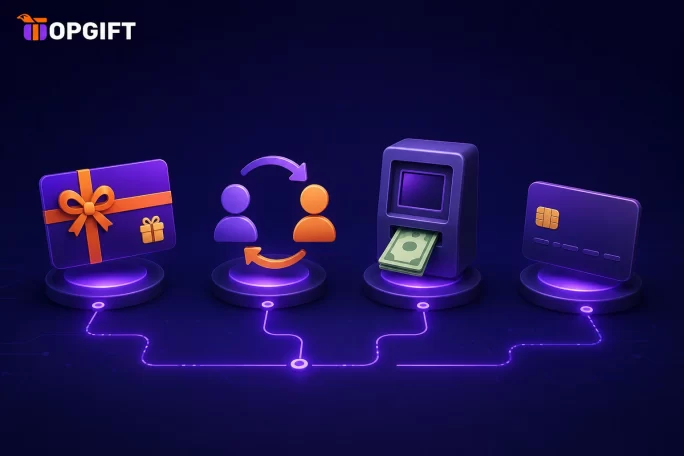
Crypto gift cards. You buy a prepaid code and redeem it into an account. No bank link, wide choice of payment methods, small amounts possible. The trade-off is a small premium over spot price.
Peer-to-peer (P2P). You buy directly from another person, often paying by methods a bank won’t flag. Flexible, but it demands more care — you’re trusting a counterparty, and scams exist if you don’t use escrow properly.
Crypto ATMs. Feed in cash, get crypto. Genuinely bank-free, but fees are steep, often well into double digits, and machines aren’t everywhere.
Prepaid cards. Load a prepaid card and use it where a normal card would go. Works sometimes, but many exchanges still reject prepaid cards, so it’s hit and miss.
No single option is best for everyone. The right one depends on how much you’re buying, how much hassle you’ll tolerate, and how much of a premium you’ll accept to keep things simple.
Gift Cards, in Detail
Of those routes, a gift card is usually the least fuss, so it’s worth explaining properly.
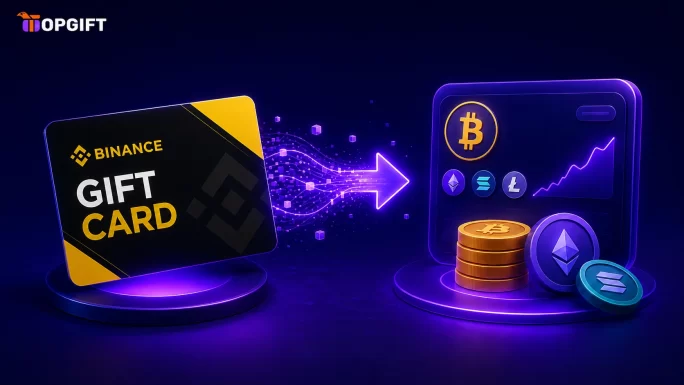
Instead of paying an exchange with a card, you buy a prepaid code from a merchant, then redeem that code into your account. Because you’re paying the merchant rather than the exchange, your bank never sees a crypto transaction at all — it sees an ordinary digital purchase, which is exactly why the decline problem largely disappears.
It also opens up payment methods a bank link wouldn’t. Card, PayPal, Apple Pay, Google Pay and crypto itself all work, so even “card” purchases route differently from a direct bank charge. And amounts start low — from $0.50 — so you’re not forced into a large first buy.
Redemption itself takes under a minute. Our step-by-step redemption guide walks through it, and our comparison of gift cards versus buying on an exchange covers the cost trade-off in full.
What You Still Can’t Avoid
Here’s the honest part that most guides skip: skipping the bank doesn’t mean skipping identity verification.
Redeeming a gift card requires a verified account on the exchange. So does buying directly. The bank link is what disappears — not the identity check. This trips people up, because they assume “no bank account” also means “no verification”, and it doesn’t. Regulated exchanges verify users regardless of how the money arrives.
If your goal was avoiding a declined card or keeping crypto off your bank statement, a gift card solves that cleanly. If your goal was total anonymity with no ID anywhere, no legitimate route offers that — and anything promising it should be treated as a scam.
Which Option Fits You
- Your card keeps getting declined: a gift card is the direct fix — it removes the bank from the transaction that’s failing.
- You want it simple and low-risk: a gift card again, since P2P and ATMs carry more hassle or higher fees.
- You’re buying a large amount and don’t mind the effort: P2P with proper escrow can be cheaper.
- You only have cash and no account of any kind: a crypto ATM works, at a cost.
- You want to start tiny: a gift card, since it has the lowest minimum by far.
Frequently Asked Questions
Can I really buy crypto without a bank account?
Yes. Gift cards, P2P, crypto ATMs and prepaid cards all let you buy without linking a bank. A gift card is usually the simplest, since you pay a merchant rather than the exchange and the bank never sees a crypto transaction.
Do I still need to verify my identity?
Yes. Skipping the bank doesn’t skip verification — regulated exchanges verify users regardless of how the money arrives. Any service promising crypto with no identity check at all should be treated with suspicion.
Why does my bank keep declining crypto purchases?
Some banks block crypto merchants by policy; others rely on fraud filters that flag the transaction type. The refusal usually comes without explanation, and retrying seldom changes it. Routing around the bank with a gift card avoids the problem.
Is a gift card cheaper than a crypto ATM?
Usually, yes. Crypto ATM fees are often well into double digits, whereas a gift card carries a smaller premium and no network fee on redemption. For most people the gift card is the better value.
Can I pay with PayPal or Apple Pay?
With a gift card, yes — card, PayPal, Apple Pay, Google Pay and crypto all work. Exchanges directly tend to accept a much narrower set of methods.
What’s the smallest amount I can buy this way?
Gift cards start at $0.50, well below the $10 to $20 minimums common on exchange card purchases, so small first buys are genuinely possible.
The Simple Route
If you’re happy to link a bank and your card works, buying directly is cheapest and there’s no reason to complicate it. But if your card keeps failing, or you’d simply rather keep your bank out of it, a prepaid code is the least-hassle way around — it skips the bank without pretending to skip the rules.
Since a gift card needs no bank link and starts at $0.50, the crypto range is a straightforward place to buy without linking anything.