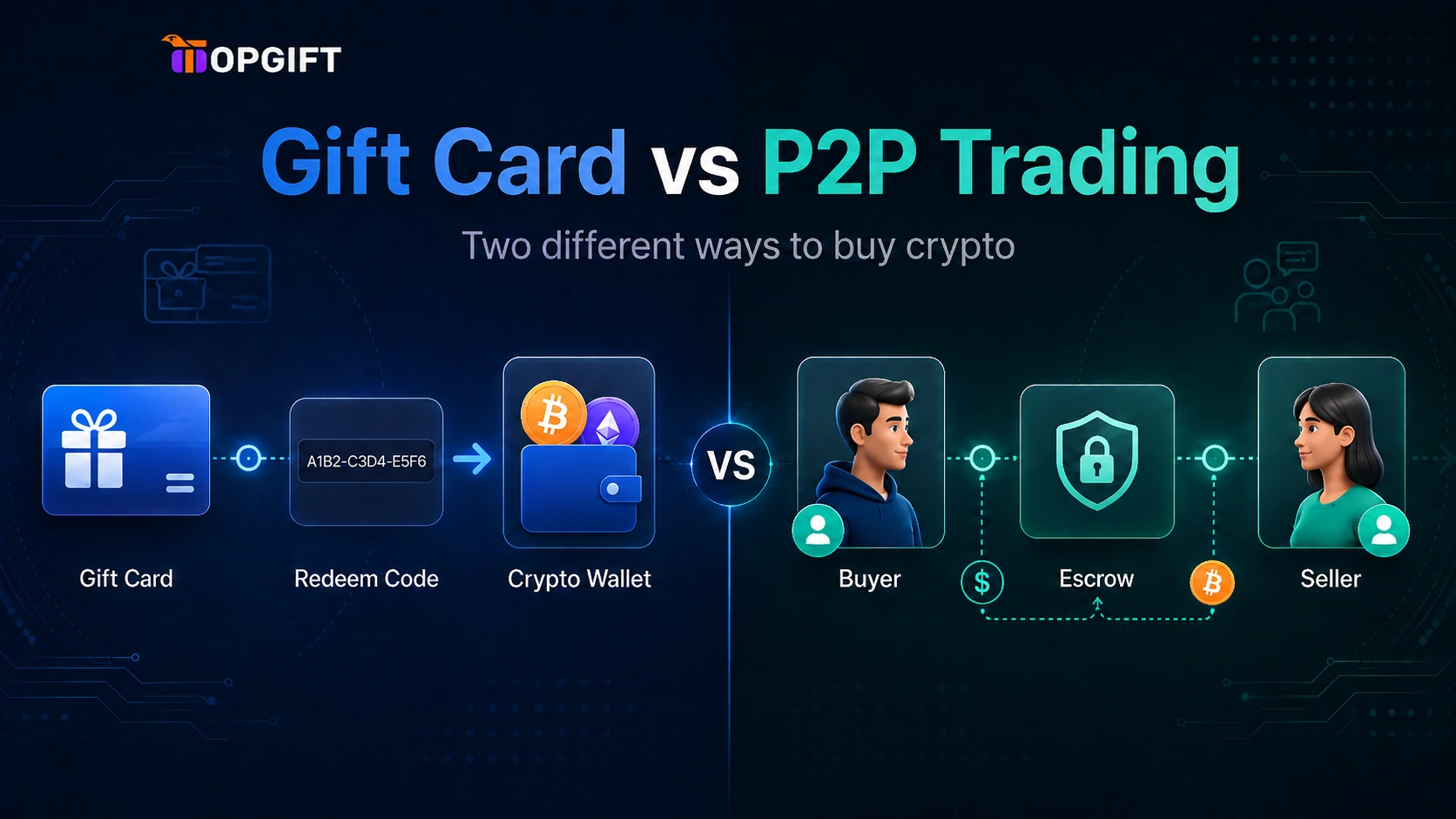
P2P trading is popular for a reason — it’s often cheaper, and it works when other routes don’t. But “cheaper” and “safer” aren’t the same thing, and P2P asks something of you that a gift card doesn’t: you have to trust a stranger, and get the details right, every single time.
This is an honest comparison of the two on safety. P2P isn’t dangerous when done carefully, and a gift card isn’t magic — but the risk surface is genuinely different, and knowing how helps you pick the right one for you.
Table of Contents
- The Short Version
- How P2P Trading Actually Works
- Where P2P Goes Wrong
- How a Gift Card Compares
- Speed, Cost and Control
- Which One Suits You
- Frequently Asked Questions
- The Safer Default
The Short Version
| Gift card | P2P trading | |
|---|---|---|
| Who you rely on | A registered merchant | An individual stranger |
| Main risk | Buying from a fake seller | Counterparty scams, chargebacks |
| Cost | Small premium | Often the cheapest |
| Effort | Low — buy and redeem | Higher — vet, chat, confirm |
| Room for mistakes | Very little | Plenty, if you’re careless |
| Best for | Simplicity and peace of mind | Lowest cost, if you’re careful |
How P2P Trading Actually Works
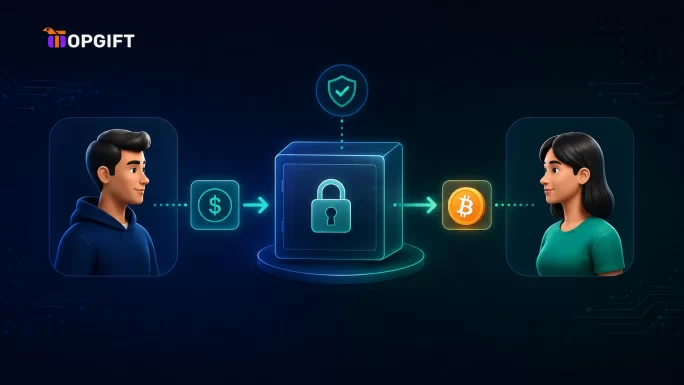
P2P — peer-to-peer — means buying crypto directly from another person rather than from an exchange’s own supply. You pay them, they send you the crypto. Most reputable platforms sit an escrow system in the middle: the seller’s crypto is locked by the platform until you’ve paid, then released to you.
Done properly, that escrow makes P2P reasonably safe. The platform holds the crypto hostage until both sides do their part, which removes the “I paid but got nothing” outcome — as long as everyone stays inside the system.
The trouble starts when people step outside it, or when a scammer engineers a situation where the protection doesn’t apply. And that happens more than beginners expect.
Where P2P Goes Wrong
The risks aren’t hypothetical — they’re the everyday failure modes of trading with strangers.
Payment reversals. A buyer pays with a reversible method, receives the crypto, then reverses the payment through their bank. The seller loses both. This is why sellers are wary, and why disputes get messy.
Off-platform pressure. A scammer tries to move you off the platform’s chat and escrow — “let’s just do it directly, it’s faster”. The moment you leave escrow, you have no protection at all. Every P2P scam guide says the same thing: never go off-platform, and yet people do, because the scammer sounds reasonable.
Fake payment proof. A buyer sends a doctored screenshot showing a payment that never arrived, and pressures the seller to release the crypto before checking. If the seller falls for it, the crypto’s gone.
Simple inexperience. Reading a counterparty’s reputation, spotting a too-good rate, knowing when a deal smells wrong — these are skills, and beginners don’t have them yet. P2P rewards experience and punishes the lack of it.
None of this makes P2P a trap. Careful, experienced traders use it safely every day. But it does mean the safety depends on you — your judgement, your discipline, your willingness to walk away.
How a Gift Card Compares
A gift card removes the counterparty entirely. There’s no stranger to vet, no escrow to stay inside, no payment that could be reversed against you, no chat where someone talks you into a mistake. You buy a code from a merchant and redeem it into your own account. That’s the whole transaction.
This collapses the risk surface dramatically. The one real risk left is buying from a fake or unofficial seller — and that’s easily managed by using a merchant listed in Binance’s own merchant directory, so the code is genuine. Compared with the several ways a P2P trade can go sideways, that’s a single, avoidable point of failure.
The redemption itself is just entering a code on the exchange — our redemption guide shows exactly where. No negotiation, no trust in an individual, no window for a scam to operate.
Speed, Cost and Control
Safety isn’t the only axis, so here’s the honest rest of it.
Cost: P2P usually wins. Buying directly from an individual often gets you a better rate than a gift card’s small premium, especially at larger sizes. If squeezing the lowest price is your priority and you’re experienced, P2P has a real edge.
Speed: a gift card is more predictable. P2P can be fast, but it can also stall while you wait for a seller to respond, confirm payment, or release escrow. A gift card redeems in under a minute, every time.
Control: a gift card keeps everything in your hands. P2P always involves another person’s cooperation, and that’s a variable you can’t fully control. For a fuller cost breakdown against buying directly, our comparison of gift cards versus buying on an exchange covers the pricing side in detail.
Which One Suits You
- You’re new to crypto: a gift card, comfortably. P2P asks for judgement you haven’t built yet, and the mistakes are expensive.
- You want the lowest possible price and you’re experienced: P2P, with care and never off-platform.
- You value simplicity and low stress: a gift card — fewer moving parts, fewer ways to get hurt.
- You’re buying a large amount and know what you’re doing: P2P’s cost advantage grows with size.
- You just want it done safely without thinking hard: a gift card, every time.
Frequently Asked Questions
Is P2P trading safe?
It can be, when you stay inside a reputable platform’s escrow and never move off-platform. The risks come from trusting a stranger, payment reversals, and inexperience — all manageable for careful traders, but real for beginners.
Why is a gift card considered safer?
It removes the counterparty. There’s no stranger to trust, no escrow to stay inside, and no reversible payment working against you. The main remaining risk — a fake seller — is avoided by buying from an officially listed merchant.
Is P2P cheaper than a gift card?
Often, yes. Buying directly from an individual can beat a gift card’s small premium, especially at larger amounts. The trade-off is more effort and more risk, which is the whole point of the comparison.
What’s the biggest P2P scam to watch for?
Being moved off-platform. Once you leave the escrow system, you lose all protection. Also watch for fake payment screenshots and payment reversals after crypto is released.
Which is faster?
A gift card is more predictable — redemption takes under a minute. P2P can be quick but may stall while waiting on a seller to respond, confirm, or release escrow.
Which should a beginner choose?
A gift card. P2P rewards experience and punishes the lack of it, so it’s a poor place to learn. A gift card’s simplicity makes it the lower-risk starting point.
The Safer Default
If cost is everything and you know your way around, P2P earns its place — used carefully, inside escrow, never off-platform. For most people, though, and especially anyone new, a gift card is the safer default simply because there are fewer ways for it to go wrong. One avoidable risk beats several manageable ones.
If a low-hassle, low-risk route is what you’re after, our Binance Gift Cards redeem straight through Binance with nothing to negotiate.