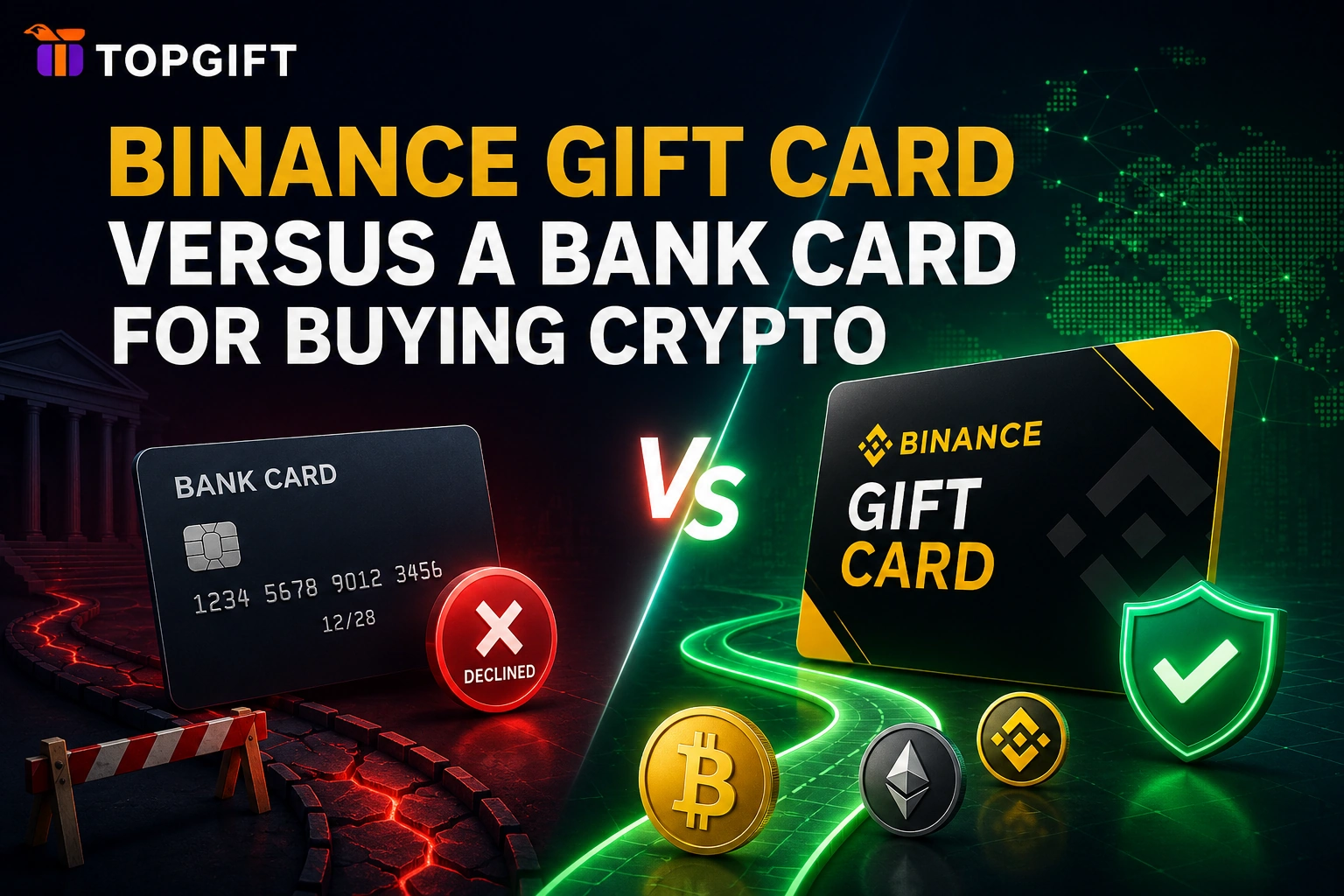
When you buy crypto, the payment method is usually an afterthought — until your bank card gets declined for no reason anyone will explain. That’s the moment people start looking at a Binance Gift Card instead, and it’s worth understanding why the two behave so differently at the checkout.
This compares paying with a Binance Gift Card against paying with a bank card directly: why one gets blocked when the other doesn’t, what each costs you, and which makes sense in which situation. A bank card is simpler and cheaper when it works — the whole question is what happens when it doesn’t.
Table of Contents
- The Short Version
- Why Bank Cards Get Declined
- What a Gift Card Does Differently
- The Trade-Offs, Honestly
- When Each One Makes Sense
- Frequently Asked Questions
- The Practical Takeaway
The Short Version
| Binance Gift Card | Bank card (direct) | |
|---|---|---|
| Risk of decline | Low | Common for crypto |
| Cost | Small premium | Cheaper when it works |
| Shows on statement as | A digital purchase | A crypto purchase |
| Payment methods | Card, PayPal, Apple/Google Pay, crypto | Card only, usually |
| Smallest purchase | From $0.50 | Often $10–20 minimum |
| Setup | Buy code, redeem | Link card to exchange |
Why Bank Cards Get Declined
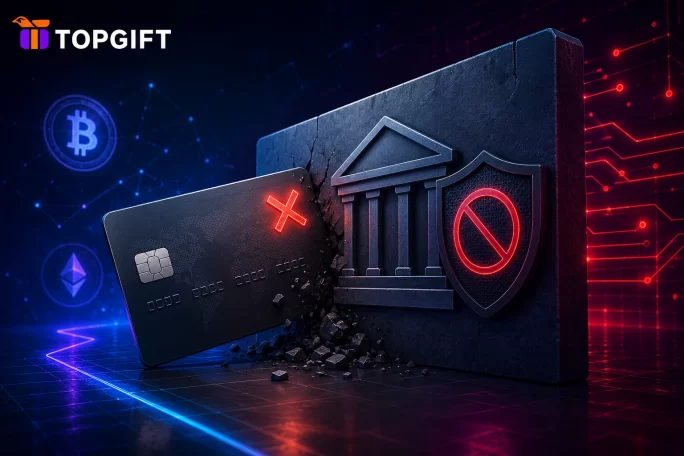
This is the part that catches people off guard, because the payment fails even though there’s plenty of money in the account. It isn’t about your balance — it’s about the bank’s attitude to crypto.
Blanket policies. Some banks simply block card payments to crypto merchants as a matter of policy. It doesn’t matter who you are or how much you’re spending; the category is off-limits, full stop.
Automated fraud filters. Even banks that allow crypto often run filters that flag these transactions as suspicious. An overseas merchant, an unfamiliar category, a first-time purchase — any of these can trip the system and freeze the payment automatically, with no human involved.
No explanation, no appeal. The worst part is the silence. The payment just fails, usually with a generic error, and retrying rarely helps because the underlying reason hasn’t changed. Most people have no idea why, and the bank’s support line often can’t say either.
None of this means anything is wrong with you or your account. It’s the bank deciding, on your behalf, that it would rather this purchase didn’t happen.
What a Binance Gift Card Does Differently
A Binance Gift Card sidesteps the whole problem by changing who you pay. Instead of paying a crypto exchange, you pay a merchant for a prepaid code. To your bank, that reads as an ordinary digital purchase — not a crypto transaction — so the filters and policies that block crypto payments simply don’t apply.
You then redeem the code into your account yourself. The crypto never involved your bank at all, beyond the initial everyday purchase of the code. That’s why a gift card works in exactly the situation where a direct card payment fails: it removes your bank from the part of the transaction it objects to.
It also widens your options. A gift card can be bought with a card, PayPal, Apple Pay, Google Pay or crypto, whereas paying an exchange directly usually means a card and little else. If your issue is a payment method the exchange won’t take, that alone can solve it. There’s more on this route in our guide to buying crypto without linking a bank account.
The Trade-Offs, Honestly
A gift card isn’t free, and it isn’t always the better choice. Here’s the balanced picture.
Cost. A bank card, when it works, is cheaper. Buying directly at spot price beats a gift card’s small premium, especially on larger amounts. The premium is what you pay for the code to exist and to sidestep the bank — a real service, but a cost nonetheless.
Simplicity, once set up. If your card is already linked and working, buying directly is a couple of clicks. A gift card adds a step: buy the code, then redeem it. Minor, but real.
The flip side. Against all that, the gift card has no minimum worth worrying about — from $0.50 versus the $10–20 an exchange often demands on card purchases — and it doesn’t put a crypto line on your bank statement. Our comparison of gift cards versus buying on an exchange digs further into the cost side.
When Each One Makes Sense
- Your bank card works fine for crypto: use it. It’s cheaper, and there’s no reason to pay a premium to fix a problem you don’t have.
- Your card keeps getting declined: a gift card is the direct answer — it removes the bank from the transaction that’s failing.
- You want to pay with PayPal or Apple Pay: a gift card, since exchanges rarely take those directly.
- You’d rather no crypto line appeared on your statement: a gift card keeps it as an ordinary digital purchase.
- You’re buying a large amount and your card works: the bank card’s lower cost matters more at size.
- You want to spend just a dollar or two: a gift card, since exchange card minimums rule that out.
Frequently Asked Questions
Why does my bank keep declining crypto purchases?
Either the bank blocks crypto merchants by policy, or an automated fraud filter flags the transaction. Both happen without explanation, and retrying rarely helps because the underlying reason hasn’t changed.
Is a Binance Gift Card more expensive than a bank card?
Usually a little, yes. A bank card at spot price is cheaper when it works. The gift card’s premium buys you a route around the decline problem and access to more payment methods — worth it in some situations, not others.
Will a gift card show up as crypto on my statement?
No. Because you’re paying a merchant for a code rather than an exchange for crypto, it reads as an ordinary digital purchase.
Can I use PayPal or Apple Pay with a gift card?
Yes. Gift cards can be bought with card, PayPal, Apple Pay, Google Pay or crypto. Paying an exchange directly usually only accepts a card.
If my card works, is there any reason to use a gift card?
Not for cost — a working card is cheaper. You might still prefer a gift card to keep crypto off your statement, to buy a very small amount, or to give crypto to someone else. Otherwise, a working card is fine.
The Practical Takeaway
This isn’t really a Binance Gift Card versus a bank card as rivals — it’s knowing which tool fits the moment. A working bank card is the cheaper, simpler choice, and if yours goes through there’s no reason to change. The gift card exists for the very common moment when the card doesn’t: the decline nobody explains, the method the exchange won’t take, the small amount the minimum won’t allow.
If a declined card is what brought you here, our Binance Gift Cards route around the problem and redeem straight through Binance.