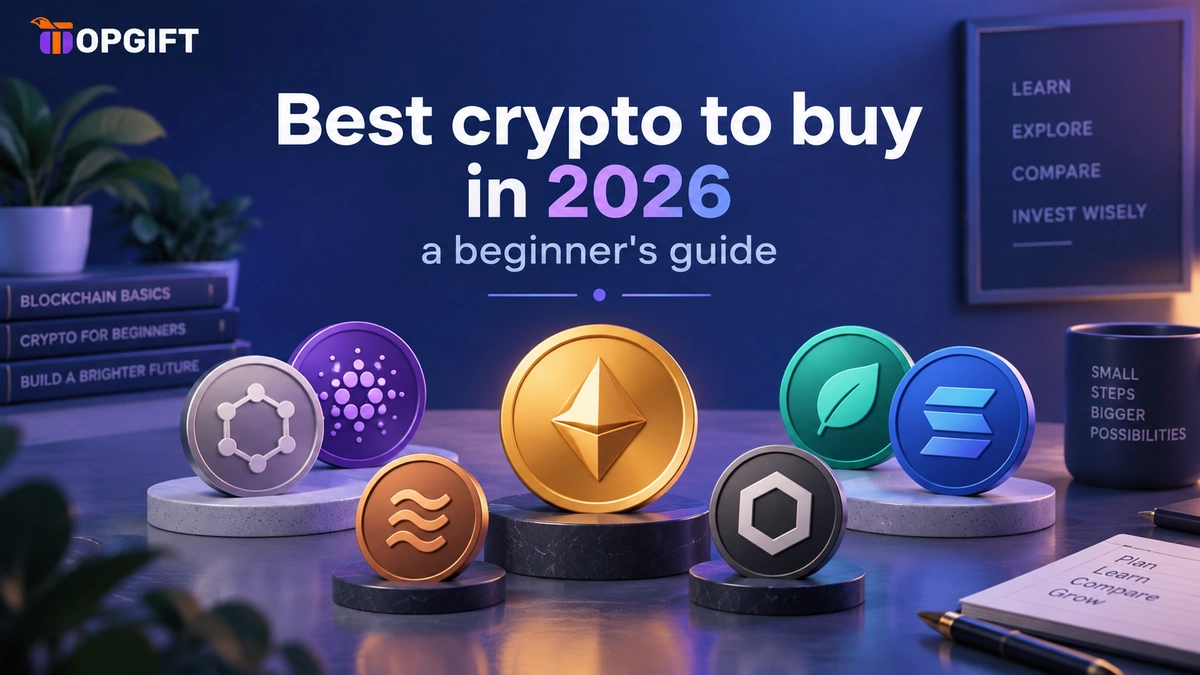
Search for the best crypto to buy and you’ll find a thousand confident answers, most of them trying to sell you something. This guide takes a different approach. Rather than predicting which coin will rise, it explains what each of the main coins actually does, who it suits, and what you’re taking on by holding it. That’s a more useful question for a beginner, because the right coin depends entirely on what you want it for.
By the end you’ll know the difference between the handful of coins that matter, how much is sensible to start with, and how to buy without linking a bank card. Nothing here is a prediction, and none of it is financial advice — it’s the plain explanation most guides skip.
In this guide
- There Is No Single Best Crypto
- Start With What You Want It For
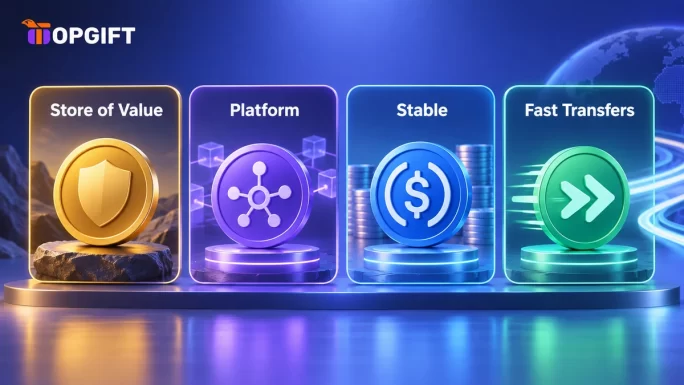
- The Main Coins at a Glance
- Bitcoin: The Store of Value
- Ethereum: The Platform
- Stablecoins: The Steady Option
- Solana and the Faster Networks
- XRP and Litecoin: Built for Moving Money
- Dogecoin and the Fun End
- How Much Should a Beginner Start With
- The Risks Nobody Should Skip
- How to Actually Buy Your First Crypto
- Frequently Asked Questions
There Is No Single Best Crypto
The first thing to accept is that “best” isn’t a property a coin has. Bitcoin and a stablecoin are both perfectly good choices, and they behave in completely opposite ways. One swings in value and is held for years; the other is designed never to move at all. Neither is better — they answer different questions.
This matters because most beginners buy the coin they’ve heard of, then discover it doesn’t do what they wanted. Someone who wanted to park money safely buys Bitcoin and panics at the first drop. Someone who wanted a long-term position buys a stablecoin and wonders why nothing happens. Consequently, the useful starting point isn’t a coin at all. It’s a purpose.
Start With What You Want It For
Ask yourself which of these sounds most like you, because each points to a different part of the market.
You want a long-term holding. Something you buy, leave alone, and check occasionally over years. You accept it can fall hard along the way. This points to Bitcoin, and for some people Ethereum.
You want to hold value without the swings. Money that stays worth what it was, but sits in crypto rather than a bank. This points to stablecoins.
You want to use crypto, not just hold it. Sending money, paying for things, moving between people or platforms. This points to the faster, cheaper networks.
You’re curious and want to learn with a small amount. Perfectly reasonable, and the best way in for most people. Almost any coin works, provided the amount is small enough that losing it wouldn’t matter.
The Main Coins at a Glance
Here’s the landscape in one view. The “what it’s for” column is the one to read first.
| Coin | What it’s for | Price behaviour | Suits |
|---|---|---|---|
| Bitcoin (BTC) | Long-term store of value | Volatile, large swings | Holders with patience |
| Ethereum (ETH) | Powering apps, DeFi and NFTs | Volatile | Those interested in the ecosystem |
| USDC | Holding steady dollar value | Designed to stay at $1 | Anyone avoiding volatility |
| Solana (SOL) | Fast, low-cost network for apps | Volatile | Users of newer platforms |
| XRP | Fast, cheap transfers | Volatile | People moving money |
| Litecoin (LTC) | Quick, low-fee payments | Volatile | Bitcoin-style, lighter |
| Dogecoin (DOGE) | Fun, small amounts | Highly volatile, hype-driven | Novelty buyers only |
Bitcoin: The Store of Value
Bitcoin is the original cryptocurrency and still the largest by a wide margin. People describe it as digital gold, and the comparison holds in one important way: nobody uses it much for everyday payments, but plenty of people hold it as a long-term store of value. Its supply is capped, its network is the most established, and it’s the coin institutions bought first when they started buying at all.
What Bitcoin isn’t is stable. It has fallen by more than half on several occasions and taken years to recover. Anyone buying it should be comfortable with that possibility, because it will likely happen again at some point. If you’re buying Bitcoin, buy it as a position you intend to leave alone, not as money you’ll need next month. There’s a fuller walkthrough in our guide to buying Bitcoin without a bank card.
Ethereum: The Platform
Ethereum is best understood as infrastructure rather than currency. A huge share of what happens in crypto — decentralised finance, tokens, digital collectibles, applications of every kind — runs on the Ethereum network. Holding ETH is closer to holding a stake in that infrastructure than to holding a store of value.
That gives it a different character from Bitcoin. Ethereum’s value is tied to how much the network gets used, which makes it interesting to people who follow the ecosystem and less obvious to people who just want a long-term holding. Its price swings just as much as Bitcoin’s, and its network fees can run high when demand spikes. Our post on buying Ethereum covers the practical side.
Stablecoins: The Steady Option
Stablecoins are the part of crypto most beginners overlook and many end up using the most. A stablecoin like USDC is designed to hold a steady value pegged to the US dollar — one coin, one dollar, and it stays there. You’re not buying it hoping it climbs; you’re buying it because it shouldn’t move.
That makes it genuinely useful. It’s where people park value between decisions, how they hold dollars without a US bank account, and what they use to send money without the receiving end worrying about the price changing overnight. For a first purchase, it’s also the gentlest possible introduction: you get to learn how wallets, transfers and exchanges work without watching your money swing while you learn. Our comparison of stablecoins and volatile coins goes deeper on the trade-off.
One caveat, and it’s worth stating plainly: “designed to stay at a dollar” is not the same as “guaranteed to”. Stablecoins have briefly slipped from their peg before. It’s the steady choice, not a risk-free one.
Solana and the Faster Networks
Solana does much of what Ethereum does — hosts applications, tokens and collectibles — but it’s built for speed and very low fees. Transactions settle in moments for a fraction of a cent, which is why a lot of newer projects launched there. If you’re interested in that side of crypto and find Ethereum’s fees off-putting, Solana is the obvious alternative.
Being newer cuts both ways. The network has grown quickly, but it doesn’t have Ethereum’s years of track record, and its price has been correspondingly dramatic in both directions. Treat it as an interest in a fast-moving ecosystem rather than a safe corner of the market. Our guide to buying Solana has the details.
XRP and Litecoin: Built for Moving Money
Two older coins share a purpose: moving value quickly and cheaply. XRP settles in seconds for a fraction of a cent and is associated with cross-border payments. Litecoin, often called the silver to Bitcoin’s gold, works much like Bitcoin but confirms faster and costs less to send.
People hold these because the transfer use case appeals to them, not usually as a long-term store of value. Both are volatile — being designed for payments says nothing about price stability, a distinction beginners often miss. If the practical side interests you, see our posts on XRP and Litecoin.
Dogecoin and the Fun End
Dogecoin started as a joke and has never fully stopped being one, which is precisely its appeal. People buy a few dollars’ worth for the novelty, as a light-hearted gift, or because owning a piece of internet history is entertaining. As an introduction to crypto it’s harmless fun, provided you treat it that way.
What it isn’t is an investment. Dogecoin moves on hype more than almost anything else, and its price can leap or collapse on a trending post. Buy it with money you’d genuinely shrug off losing. Our take on buying Dogecoin keeps that tone throughout.
How Much Should a Beginner Start With
Less than you think. The point of a first purchase isn’t to make money — it’s to learn how everything works while the stakes are low. You want to see how buying, redeeming, transferring between wallets and checking a balance actually feel, and you want to do that with an amount that wouldn’t ruin your week.
| If you want to… | A sensible starting amount |
|---|---|
| Just see how it works | A dollar or two |
| Learn and hold something meaningful | What you’d spend on a meal out |
| Build a long-term position | Only what you can leave untouched for years |
| Try a fun coin like Dogecoin | Pocket change, deliberately |
The old advice still holds: never put in money you need. Crypto’s defining feature for a beginner isn’t the upside, it’s the volatility, and the only reliable protection against that is size. More on this in our note on buying crypto in small amounts.
The Risks Nobody Should Skip
Every honest guide needs this section, and most guides bury it. Here’s what you’re actually taking on.
- Volatility. Prices fall as well as rise, sometimes by half or more. This isn’t a rare event in crypto; it’s a recurring feature.
- Irreversibility. Crypto transactions can’t be undone. Send to the wrong address and there’s no bank to call.
- Scams aimed at beginners. Fake giveaways, fake support, fake platforms. Newcomers are targeted deliberately, which is why our guide to common crypto scams is worth reading before you buy anything.
- Losing access. Lose your keys or your account access and the crypto may be gone permanently.
- Regulatory change. Rules differ by country and shift over time. What’s available to you can change.
- Depeg risk on stablecoins. Rare, but real. Steady is not the same as guaranteed.
None of this means avoid crypto. It means enter it with small amounts, verified platforms and clear eyes. This is general information, not financial advice.
How to Actually Buy Your First Crypto
The mechanics stop more beginners than the choice of coin does. Paying an exchange directly with a bank card fails surprisingly often — banks block crypto merchants outright, fraud filters freeze the payment, and card minimums rule out the small first purchase that makes sense for a beginner.
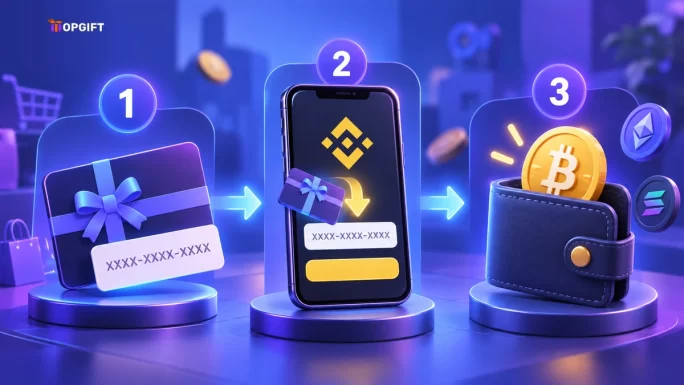
A Binance Gift Card sidesteps all of that. You buy a prepaid code, redeem it on Binance, and the crypto is credited to your account. Your bank only ever sees an ordinary digital purchase, so none of the card-decline problems apply. Cards start at very small amounts, which is exactly right for a first try, and there’s no network fee on redemption. Our step-by-step redemption guide walks through it with screenshots.
From there it’s simple: pick the coin that matches your purpose, choose a small amount, redeem, and take your time learning what you’ve bought. Browse the full Binance Gift Card range to see which coins are available.
Frequently Asked Questions
What is the best crypto for a complete beginner?
It depends what you want. For learning without volatility, a stablecoin like USDC is the gentlest start. For a long-term holding, most people begin with Bitcoin. There’s no single right answer, only the one that matches your purpose.
How much money do I need to start?
Very little. Gift cards start at well under a dollar, so you can buy a fraction of a coin purely to see how it works. Starting small is the sensible approach regardless of budget.
Should I buy several coins or just one?
For a first purchase, one is plenty. Understanding a single coin and how to handle it is more valuable than spreading a small amount across five. You can always add later.
Is it too late to buy Bitcoin?
Nobody can answer that honestly, and anyone who claims to is guessing. Bitcoin is divisible into tiny fractions, so you never need to buy a whole one. Whether it suits you depends on your time horizon and tolerance for large price swings, not on timing the market.
What is the safest cryptocurrency?
Stablecoins carry the least price risk, since they’re designed to hold a fixed value. No crypto is risk-free, though — platform risk, scams and loss of access apply to all of them.
Can I buy crypto without a bank card?
Yes. A gift card lets you buy a prepaid code and redeem it into crypto on an exchange, with no bank card linked to the purchase at any point.