For years, crypto in Europe worked under a patchwork of national rules. Each country had its own registrations, and exchanges could serve the whole continent with very little oversight. That era ended on 1 July 2026. From that day, the EU’s Markets in Crypto-Assets regulation, known as MiCA, applies in full across all member states.
The change has been bigger than most people expected. The world’s largest exchange paused its services for EU residents. The world’s largest stablecoin vanished from regulated European platforms. Thousands of smaller companies lost the right to serve EU customers. This guide explains what happened, why it happened, and what it actually means for your own crypto.
In this guide
What MiCA Actually Is
MiCA is a single rulebook for crypto across the European Union. It replaces the old national systems with one licence, called a Crypto-Asset Service Provider licence, or CASP licence for short.
A company that gets this licence in one EU country can offer its services in all 27 member states. That is known as passporting. A company without it can no longer legally offer crypto services to EU customers at all.
The rules cover two main areas. The first is platforms: exchanges, brokers, custodians and similar services. They must meet standards on capital, security, customer protection and anti-money-laundering controls. The second is stablecoins. Any stablecoin offered to EU users must come from an issuer that holds the right authorisation and keeps its reserves under strict conditions.
In short, MiCA doesn’t ban crypto. It decides who is allowed to provide it.
How MiCA Rolled Out
MiCA didn’t arrive overnight. It came into force in stages over three years, which is why many people only noticed it at the very end.
| Date | What happened |
|---|---|
| June 2023 | MiCA enters into force |
| 30 June 2024 | Stablecoin rules start to apply |
| 30 December 2024 | Rules for exchanges and other platforms apply, and national transition periods begin |
| December 2024 – 2026 | Licensed exchanges gradually delist USDT for EU users |
| 24 June 2026 | Binance withdraws its licence application in Greece |
| 1 July 2026 | Transition ends — unlicensed platforms must stop serving EU customers |
The long transition explains why the final date caught so many users off guard. Right up to the end of June 2026, many platforms kept working as normal under their old national registrations. Then the grace period closed, and anything unlicensed had to stop.
What Happened to Binance
Binance, the largest crypto exchange in the world, was the biggest name caught by the deadline. It had applied for its MiCA licence in Greece. On 24 June 2026, six days before the cut-off, it withdrew that application. Reports at the time suggested the Greek regulator was preparing to reject it, with concerns reportedly focused on the company’s anti-money-laundering history.
Without a licence, Binance had to limit what it offers EU residents. From 1 July 2026, EU users can no longer open new accounts, place new orders, make deposits or use Earn and staking products. Withdrawals remain open, and Binance says user funds are safe and held one to one.
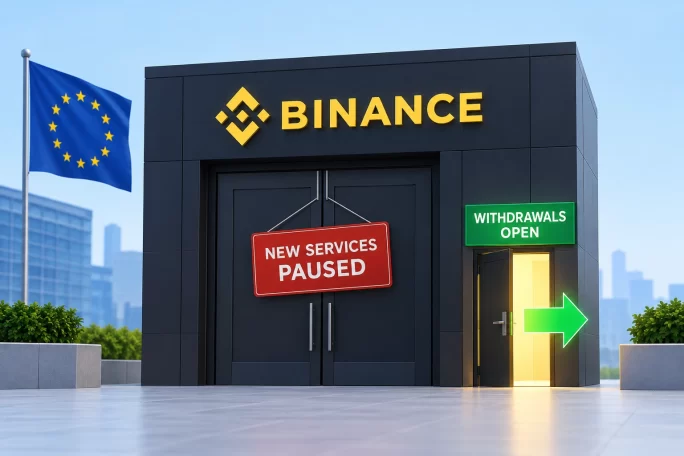
Binance describes this as a pause rather than an exit. It has said it expects to secure a licence in the coming months, reportedly through France’s market regulator. As of September 2026, however, no licence has been granted, and there is no confirmed date for a return.
For EU residents with an existing account, day-to-day use has changed less than the headlines suggest. Binance Gift Cards still redeem as before, with one exception: USDT gift cards are no longer available to EU users, in line with MiCA’s stablecoin rules.
Why USDT Disappeared From EU Exchanges
The second big change affects the most popular stablecoin in the world. Under MiCA, a stablecoin linked to a single currency counts as an e-money token. Its issuer needs a specific authorisation to have it offered on regulated EU platforms.
Tether, the company behind USDT, chose not to apply. It has objected to MiCA’s reserve rules, which require a large share of reserves to sit in European bank accounts. As a result, licensed exchanges have removed USDT for EU users. Coinbase was among the first, back in December 2024. Others followed through 2025 and the first half of 2026.
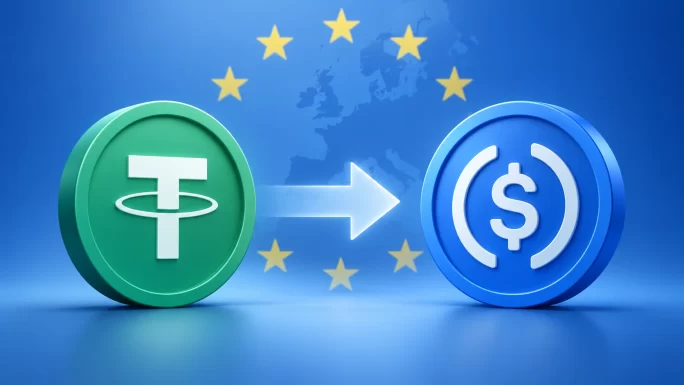
Circle took the opposite approach. Its USDC and its euro stablecoin, EURC, are authorised under MiCA through a French licence. On regulated EU platforms, USDC has effectively replaced USDT as the default dollar stablecoin.
If you have read our guide to choosing a USDT network, the same network logic applies to USDC. It also exists on several blockchains, and sender and receiver still have to use the same one.
Which Exchanges Are Licensed
Only a small share of crypto firms made it through. Out of more than 3,000 companies active in Europe, roughly 210 had full authorisation by the deadline. That is a pass rate of around seven percent.
Several of the best-known platforms are among them. Coinbase, Kraken, OKX and Crypto.com all secured MiCA authorisation and can now serve customers across the whole EU. A number of European platforms and banks have been licensed too.

The list changes over time. New licences are granted, and in rare cases they can be withdrawn. That is why checking the official register, explained below, is more reliable than any list in an article, including this one.
What MiCA Means for You
How MiCA affects you depends on where your crypto sits today. Here are the most common situations.
If you still have funds on Binance. Your balance remains accessible, and you can withdraw it. The main question is whether you want to keep funds on a platform that can’t currently offer you new services in the EU. Many users have moved their crypto either to a licensed exchange or to a wallet they control themselves.
If you hold USDT. Holding USDT is not illegal. What changed is where you can trade it. Licensed EU exchanges no longer offer it, so many users convert to USDC or EURC. Others move USDT to a self-custody wallet, where MiCA’s platform rules don’t apply in the same way.
If you are choosing an exchange now. Pick one with MiCA authorisation. A licensed platform has to meet EU standards on custody, security and customer protection, and it can’t simply vanish from your country overnight because of a missing licence.
If you use self-custody. Very little changes. MiCA regulates companies that provide services, not individuals holding their own keys. Our guide to crypto wallets explains how self-custody works and what responsibility comes with it.
None of this is legal or financial advice. It is a plain summary of what changed, so you can decide what suits your own situation.
How to Check If a Platform Is Licensed
The European Securities and Markets Authority, known as ESMA, keeps the official register of MiCA-authorised firms. Checking it takes a couple of minutes and removes any guesswork.
- Open ESMA’s website and find its register of crypto-asset service providers authorised under MiCA.
- Search for the platform’s name — try the brand and its legal company name.
- Check who licensed it and for what — the register shows the authorising country and the services covered.
- Match the entity to the app you use — compare it with the company named in the platform’s terms of service.
One detail matters here. A company’s global brand may be licensed through one specific EU entity. Make sure the app or website you use actually belongs to that licensed entity, and not to an offshore sister company with a similar name.
The Scams That Follow Every Deadline
Every major regulatory change brings a wave of scams, and MiCA is no exception. Unlicensed platforms have had to tell EU customers to withdraw their funds. Fraudsters copy exactly those messages.
The fake versions usually create urgency. Your account “will be frozen” unless you act today. You must “verify your wallet” through a link, or move funds to a “safe” address the message provides. Some even impersonate regulators.
For more warning signs, our guide to scams in 2026 covers the pressure tactics that most schemes share.
What Comes Next
MiCA is not the final word. The European Commission has already started reviewing the rules, and some changes may follow. Regulators in several countries have also pushed for tighter, more central supervision of the largest crypto firms.
Binance’s future in the EU remains open. If it secures a licence, it could restore services across the bloc. Until then, it is worth watching Binance’s official announcements for EU users, since the rules for new accounts and products may change.
For stablecoins, the direction is clearer. More authorised euro and dollar stablecoins keep arriving, many issued by banks and licensed payment firms. For everyday users, that means more regulated options, even if the most famous stablecoin is no longer among them.
Frequently Asked Questions
What is MiCA?
MiCA, the Markets in Crypto-Assets regulation, is the EU’s single rulebook for crypto. It requires platforms and stablecoin issuers serving EU users to hold an EU licence, and it applies in full from 1 July 2026.
Is Binance banned in the EU?
Not banned. Since 1 July 2026, Binance has limited some services for EU residents while it seeks a MiCA licence. Existing users can still redeem Binance Gift Cards, except USDT cards, which aren’t available in the EU.
Is it illegal to hold USDT in the EU?
No. Holding USDT is not illegal. Licensed EU exchanges simply can’t offer it, because its issuer doesn’t hold MiCA authorisation.
Which stablecoins are MiCA compliant?
USDC and EURC from Circle are the best known. A growing number of euro stablecoins from authorised European banks and payment firms are compliant too.
How do I know if my exchange is licensed?
Check ESMA’s official register of authorised crypto-asset service providers. Search for the company name, and confirm the entity matches the app or website you use.
Do I need to do anything if I use a self-custody wallet?
Usually not. MiCA regulates service providers, not individuals holding their own keys. Your wallet keeps working as before.
🔑 Key takeaways
- Since 1 July 2026, only MiCA-licensed platforms can offer crypto services to EU residents.
- Binance has paused new services for EU users — withdrawals still work, but deposits, trading and sign-ups don’t.
- USDT is gone from licensed EU exchanges but is not illegal to hold; USDC and EURC are the compliant options.
- Check ESMA’s register before trusting any platform, rather than relying on a list in an article.
- Ignore any “urgent withdrawal” message that gives you an address — it is a scam.